Frontier MechanicsField report / 102
Frontier Mechanics Week 102: MRV heads for GEO, glass carries the package, Atoms raises $1.7 billion, and a vine robot enters the spine
A two-armed spacecraft began a yearlong trip to its first service calls, Intel found a manufacturing partner for glass chip packages, a robotics holding company acquired a formidable balance sheet, and a two-millimeter robot learned to advance without dragging its body.
The interesting machines this week all moved a burden away from the place where it had become expensive. Northrop Grumman launched a robotic vehicle that brings tools to satellites never meant to see a mechanic. Intel and Lens Technology proposed moving large-package stability from organic laminate into glass. Atoms raised $1.7 billion to carry the unglamorous deployment work around industrial robots. Vine4Spine advanced through a spinal canal by growing at its tip instead of pushing friction down its shaft.
That is more than a neat editorial coincidence. Mature technical systems often stall because load accumulates at an interface: a satellite runs out of station-keeping propellant, a package bows until fine traces miss their landing pads, an autonomy model meets a quarry's maintenance schedule, or a catheter transmits shear into tissue. The frontier move is not always a more capable component. Sometimes it is a new place for the force, risk, or capital to go.
Orbital robotics
MRV turns a stranded satellite into a service address
On July 21, a Falcon 9 launched Northrop Grumman SpaceLogistics’ Mission Robotic Vehicle with three Mission Extension Pods. MRV carries the Robotic Servicing of Geosynchronous Satellites payload developed through DARPA and the U.S. Naval Research Laboratory. It is now beginning a roughly yearlong electric-propulsion climb to geosynchronous Earth orbit, where SpaceLogistics plans to operate it for more than a decade.
The payload is closer to a mobile machine shop than the word servicer usually suggests. It has two manipulator arms, each with seven articulated joints, plus cameras, lighting, a tool drive, and interchangeable end effectors. DARPA lists inspection, relocation, upgrades, and anomaly resolution among the jobs. The first commercial task is narrower and economically cleaner: use the arms to attach self-contained propulsion pods that can add six or more years to a client satellite’s useful life.
That separation of roles is the clever part. MRV supplies mobility, sensing, manipulation, and expensive dexterity. A Mission Extension Pod supplies the propulsion that stays behind. One robot can therefore service several clients instead of permanently becoming the attitude-control system for the first one. The pod is a consumable; the robotic vehicle is infrastructure. SpaceLogistics’ earlier Mission Extension Vehicles remain attached while they provide service, so MRV changes the capital turnover of the servicer as much as its mechanical capability.
Getting close is a navigation problem before it is a robot-arm problem. At GEO, two objects that appear stationary above Earth can still have relative inclination, eccentricity, longitude drift, and attitude motion. MRV must acquire a client optically, estimate its relative state, approach through planned hold points, preserve a retreat trajectory, and avoid contaminating sensitive surfaces with thruster plumes. The target may have poor visual markers and uncertain flexible-body behavior because most of the installed fleet was not designed for rendezvous.
Contact then turns estimation error into structural load. A seven-joint arm has redundancy: several joint configurations can place the same tool pose, allowing the controller to avoid singularities and keep clear of solar arrays. Redundancy also enlarges the verification problem. Joint backlash, thermal distortion, camera calibration, contact compliance, spacecraft attitude control, and communication delay couple into one maneuver. On Earth, the test stand reacts against the floor. In orbit, every arm acceleration pushes the base spacecraft the other way and can excite a captured client’s appendages.
The yearlong transfer is the other revealing trade. Electric propulsion produces low thrust but high specific impulse, exchanging time for propellant efficiency. That is sensible for a massive vehicle expected to perform many GEO maneuvers, and inconvenient for a market waiting to see revenue. The transfer also exposes avionics, power, thermal control, and propulsion to a long commissioning phase before the robot closes its first commercial task. A successful launch removed launch risk; it did not yet validate servicing.
MRV’s public-private structure deliberately places that gap on both sides of a contract. DARPA funded and led the robotics development with NRL. SpaceLogistics integrated the payload, owns and operates the spacecraft, and receives commercial servicing rights. NASA added civil-servicing expertise in 2024. After the demonstrations, SpaceLogistics must provide mission data to the government, while DARPA intends to transition coordination into the Space Force’s servicing and logistics portfolio. The government bought down a market’s first technical risk rather than buying a vehicle and shelving it after a demo.
The strongest case for this architecture is the installed base. GEO spacecraft are expensive, revenue-producing assets whose transponders or sensors may remain healthy after their original propellant margin is gone. Extending one asset can defer replacement manufacturing and launch. The hard commercial question is whether service price, insurance, lost-revenue risk during rendezvous, and the client’s remaining payload value leave enough surplus to support a fleet of servicers. A six-year extension is not valuable if the payload is obsolete in two.
There is also an unavoidable security symmetry. The sensing, proximity operations, manipulation, and relocation needed to repair a satellite can inspect or disable one. Intent is not visible in a kinematic state estimate. Client consent, approach notifications, keep-out practices, telemetry sharing, and attribution therefore belong to the architecture, not a policy appendix. Making satellite servicing routine requires making an unexpected approach legible.
Advanced packaging
Glass gives the chip package a flatter place to become a system
Intel and Lens Technology announced on July 24 that they will explore glass-substrate packaging for future AI and data-center systems. Intel brings package architecture and process development; Lens brings precision glass processing, laser manufacturing, and production scale. The verbs matter. The release describes a strategic collaboration and potential areas of cooperation, not a qualified substrate, committed factory, customer design, or shipment date.
Today’s organic build-up substrates are layered composites. Copper traces and vias are patterned through resin-based dielectric layers around a core. They are manufacturable, familiar, and inexpensive relative to silicon, but their dimensions change with heat and moisture. Copper, resin, silicon, molding compound, solder, and the board beneath expand at different rates. A package heated during assembly or operation therefore develops internal strain. Across a large footprint, small mismatches integrate into visible bow and local stress.
Warpage is not a cosmetic defect. Lithography and inspection tools have finite depth of focus. A bowed panel degrades layer-to-layer overlay, while shifted pads reduce the process window for fine-pitch connections. During solder reflow, curvature can produce opens, bridges, or nonuniform joint loading. Later thermal cycles work the same interfaces repeatedly. As chiplet count and package size rise, the industry is asking organic material to hold a larger mechanical lever arm while landing denser electrical features.
Glass changes that constraint because its composition can be tuned for dimensional behavior, its surface can be made extremely flat, and it remains stable through high-temperature processing. Intel’s earlier development work claimed 50 percent less pattern distortion and a possible tenfold increase in interconnect density relative to organic substrates, while enabling larger chiplet assemblies. A transparent, electrically insulating core can also accept through-glass vias and embedded passive or optical structures. Those are engineering targets, not yet a yield table.
Glass does not remove mechanics. It changes them. The material is stiff and dimensionally stable but brittle; edge flaws, laser-induced damage, and stress around thousands of vias can initiate cracks. Metallization has to adhere. Vias need acceptable taper, roughness, resistance, and filling yield. Thin glass panels must survive handling through wet chemistry, lithography, lamination, dicing, and assembly. Every step that was forgiving on organic laminate has to be reconsidered around fracture statistics.
A Sony study of glass-core packages illustrates the bargain. Its glass package showed less warpage change with temperature and moisture than a low-CTE organic comparison, but thermal cycling exposed a glass failure mode called SeWaRe. The researchers traced reliability margin partly to stress from the build-up layers and showed that their thickness mattered. The stable core had not abolished stress; it had become the place where stress needed to be managed. This is the recurring law of advanced packaging: every solved interface promotes another one.
That makes Lens more than a supplier of shiny sheets. Precision laser processing determines how quickly and cleanly a panel can receive a dense via field. Large-scale glass manufacturing determines thickness variation, edge quality, defect inspection, panel handling, and cost. Intel can design an elegant substrate stack, but a commercial platform needs a tool ecosystem and statistical process control that deliver usable panels repeatedly. The collaboration is an attempt to connect semiconductor tolerances to a company accustomed to manufacturing precision glass at consumer-electronics scale.
The strongest counterargument is that organic substrates will not stand still. Better low-CTE materials, coreless designs, redistribution layers, embedded silicon bridges, and localized interposers can place high density only where it earns its cost. Glass must beat that moving system, not today’s weakest laminate. It also has to integrate with assembly houses, inspection tools, design rules, reliability models, and customer qualification. A material advantage can spend years waiting for the rest of the production line to believe it.
So the announcement should be read as an ecosystem signal. Intel has spent more than a decade on glass and still chose to foreground a manufacturing partner in 2026. That tells us where the risk has migrated. The science case for flat, stable glass is credible. The frontier is drilling, plating, laminating, inspecting, and yielding it cheaply enough that package designers can rely on the claimed geometry. Moore’s Law now includes the panel handler.

Industrial autonomy
Atoms raises a robotics round sized like deployment infrastructure
Andreessen Horowitz announced on July 22 that it is backing Atoms, the physical-AI company built from Travis Kalanick’s City Storage Systems and CloudKitchens work. TechCrunch reported a $1.7 billion funding round led by a16z, with Bain Capital, Fifth Wall, Uber, and others participating; Ben Horowitz is joining the board. Atoms now presents three divisions—Food, Mining, and Transport—and an eight-year history behind its public debut.
Pronto, acquired into Atoms Mining earlier this year, supplies the best hard evidence under the new umbrella. At Heidelberg Materials’ Lake Bridgeport quarry, its autonomous haulage system moved more than two million tons of limestone over eight months. The deployment mixed Caterpillar 775G and Komatsu HD605 trucks, and Pronto says two additional Heidelberg sites are scheduled for 2026. That is a better denominator than robot count because the customer buys material moved through a process.
A quarry is unusually favorable terrain for autonomy and still not easy. Routes are constrained and repeated, access can be controlled, and vehicles move below highway speed. But dust obscures cameras and lidar, payload changes braking distance, grades change energy use, tires deform, haul roads move, rain alters traction, and excavators or human-driven equipment enter the scene. Localization, perception, prediction, dispatch, vehicle control, and a safety envelope have to remain coherent across a twelve-hour shift, not a polished demonstration lap.
The system boundary extends into operations. A dispatcher assigns trucks to loaders and crushers so neither waits unnecessarily. Vehicle health changes the available fleet. A blocked road changes every estimated arrival. Wireless coverage and map updates have failure modes. Remote operators need a queue that surfaces the right exception instead of asking one person to watch twenty video feeds. Autonomy creates value when the mine’s tons-per-hour and safety exposure improve after interventions, downtime, maintenance, and supervision are included.
Pronto’s OEM-agnostic claim is especially important. Retrofitting an existing mixed fleet saves a mine from replacing serviceable trucks and expands the addressable market beyond greenfield megaprojects. It also means the autonomy stack must normalize different steering actuators, braking behavior, CAN messages, geometry, sensor mounts, and maintenance practices. Each supported truck is partly a new robot. The platform is real if new sites and vehicle models require bounded integration work rather than a fresh engineering expedition.
This is where a $1.7 billion balance sheet can act like technical architecture. Industrial customers care whether the vendor can support hardware for years, carry spare inventory, insure performance, finance deployments, hire field teams, absorb a delayed site, and survive a safety investigation. A cash-rich parent can acquire missing subsystems and standardize procurement across divisions. Capital does not solve autonomy, but a shortage of patient capital can kill a functioning system between pilot and fleet rollout.
The round’s size also creates a capital-allocation problem disguised as ambition. Food automation, quarry haulage, and transport platforms share pieces of perception, scheduling, facilities, and fleet operations. They do not automatically share customers, safety cases, hardware, or deployment teams. A holding company earns its complexity when common infrastructure materially lowers the cost or time of each business. If the divisions merely share a founder story and a treasury, Atoms becomes a conglomerate before it becomes a platform.
a16z’s defense is that specialized robots are better suited to most industrial jobs than general humanoids. That is mechanically persuasive. A purpose-built haul truck already has the payload, wheels, powertrain, and duty cycle a mine needs; adding autonomy to it avoids the efficiency penalty of imitating a human body. The less comfortable part of the firm’s essay is its notion that rapid usefulness creates a social license. Popular demand does not replace permitting, worker consultation, incident disclosure, or public accountability, particularly when a machine’s failure can be physical.
Atoms should publish a scorecard strict enough to survive its own rhetoric: paid autonomous tons moved; fleet availability; safety-critical disengagements per operating hour; remote interventions; deployment time by new site and vehicle type; maintenance cost; and contribution margin after field support. For Food and Transport, the equivalent unit should be equally physical. A billion-dollar robot company can buy many impressive machines. It becomes infrastructure only when the machines stay gainfully employed.

Medical soft robotics
Vine4Spine removes the sliding shaft from spinal navigation
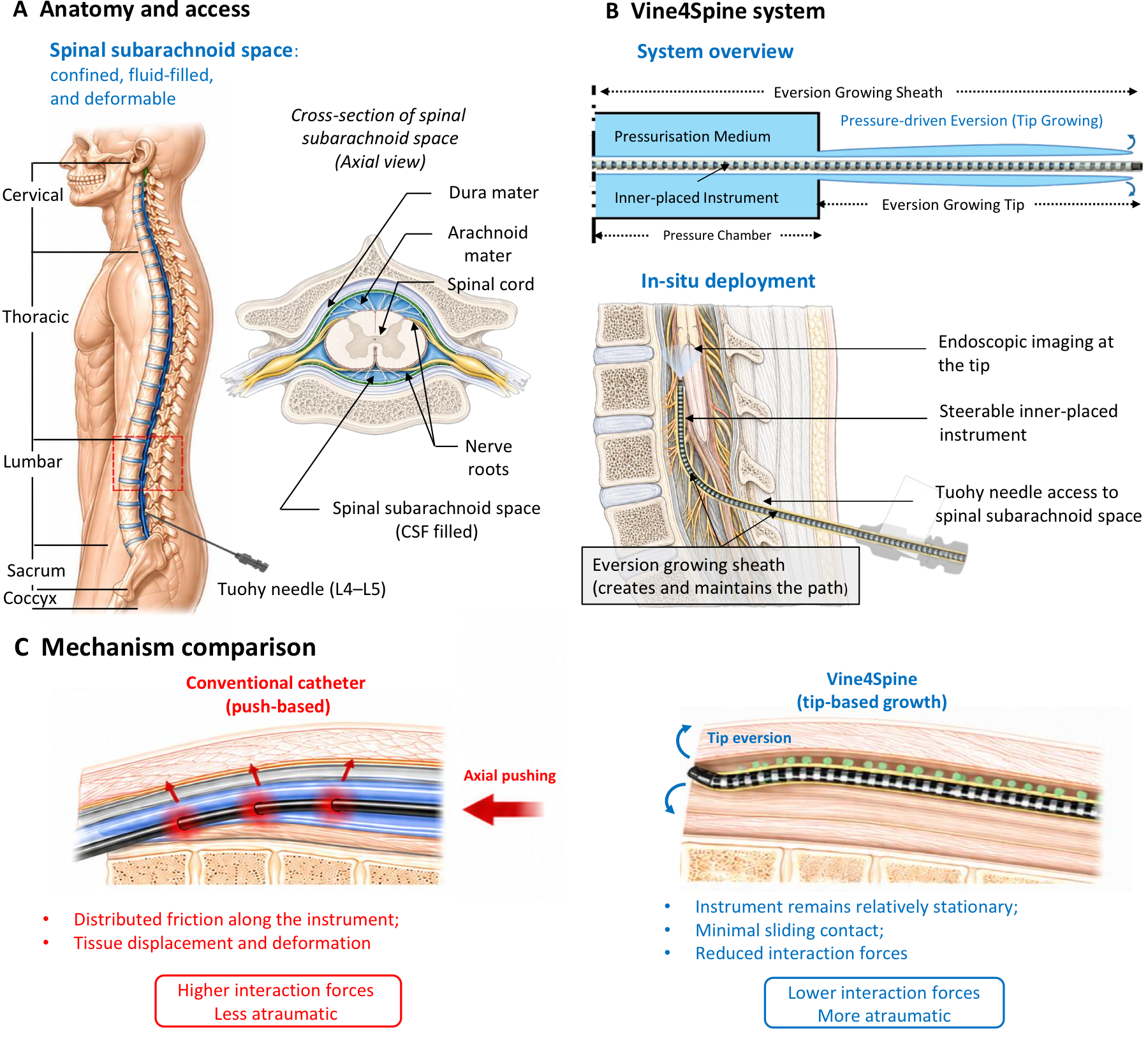
A team from King’s College London, Queen Mary University of London, the University of Thessaly, and the National Technical University of Athens submitted a striking result on July 21: a two-millimeter-diameter robot that extended 150 millimeters through the spinal subarachnoid space of an intact human cadaver while providing fluoroscopic and tip-mounted endoscopic views.
The spinal subarachnoid space is the cerebrospinal-fluid-filled corridor inside the dura and around the cord and nerve roots. Gross lumbar dimensions overstate the room available to an instrument; the paper cites an average lateral space of roughly 2.5 millimeters on each side of the cord. The boundaries are compliant, the contents are delicate, and the path changes across vertebral levels. A few millimeters of access is generous until the robot itself is two millimeters wide.
Conventional catheters move by proximal pushing. The operator applies axial load at the base, the shaft slides through its surroundings, and friction accumulates along its length. More push is needed to overcome that distributed resistance; when static friction breaks, the tip can jump. Steering commands are also filtered by shaft compliance and contact. In a blood vessel these effects are familiar. Beside spinal neural structures, the same stick-slip and shear have a particularly unattractive failure cost.
Vine4Spine changes the relative motion. A thin PTFE sheath is folded inside a pressure chamber and turns inside out at the distal end as saline pressure rises. New material appears at the tip while the already deployed outer surface remains nearly stationary against its surroundings. Imagine pushing a sock forward by rolling its cuff rather than dragging the entire sock over a table. The path length increases, but the shaft does not need to scrape forward through the tissue along that full length.
The robot is not only an inflatable tube. A steerable inner instrument runs coaxially through the growing sheath. A tendon bends a notched nitinol segment, and a miniature 320-by-320-pixel chip-on-tip camera with fiber illumination supplies an internal view. The inner instrument determines direction; the sheath everts along the chosen path and then maintains it. That division allows the soft outer layer to minimize sliding while a more structured core carries imaging and, eventually, a working tool.
Miniaturization makes the actuation less elegant than the cartoon. The sheath and inner instrument remain frictionally coupled inside the chamber. If both advance incorrectly, material can bunch at the base or tip; if the inner catheter lags, the imaging and steering geometry misaligns. The team therefore uses a pressure-and-motion duty cycle. High pressure couples the parts and everts a small length. A low or sub-atmospheric phase reduces and manages the coupling while the instrument retracts into alignment. Growth is a repeated mechanical handshake, not continuous inflation.
That control detail is the most transferable part of the paper. Pressure is doing at least three jobs: producing distal growth, changing contact between the folded layers, and stabilizing the sheath during realignment. The researchers found that symmetric commanded motion did not produce symmetric effective motion because membrane contact and friction have hysteresis. They tuned retraction ratio and introduced vacuum during depressurization. A beautiful biological analogy survived only after the team accounted for an extremely ordinary nuisance: things rub differently depending on what happened one cycle ago.
In an anatomical phantom, the team compared eversion with matched push-based insertion. Vine4Spine reduced mean interaction force by 65.2 percent and peak force by 48.0 percent. A finite-element model suggested why: the everted sheath spread contact over a larger interface while reducing concentrated stress and interfacial shear near the advancing tip. Lower force was not simply a slower insertion profile. The mechanism changed where the tissue carried load.
The cadaver experiment then tested whether the bench advantage survived a clinically recognizable route. The team entered at the lumbar level, used an introducer and saline flushing, and combined fluoroscopy with the onboard endoscope. The robot completed 150 millimeters of controlled extension across multiple vertebral levels with steering adjustments. Subsequent laminectomy and durotomy found no observable macroscopic disruption of the dura or surrounding neural structures.
That is excellent feasibility evidence and a deliberately limited safety claim. One preserved anatomy does not reproduce living tissue perfusion, patient movement, pressure dynamics, inflammatory response, microscopic injury, or anatomical diversity. “No observable macroscopic disruption” is not the same as no injury. A future system also needs sterile disposable elements, reliable pressure containment, a recovery strategy for a torn or stuck sheath, quantitative limits near nerve roots, and a procedure for retraction. Growing safely into a corridor is only half a clinical round trip.
MRV carries dexterity to a satellite instead of retiring it with unused payload. Glass carries package geometry so organic warpage does not consume the interconnect budget. Atoms carries field operations and capital around robots that already know how to move. Vine4Spine carries friction back into a pressure chamber instead of down a spinal canal.
None of the four has escaped burden. MRV inherits a yearlong transfer and dual-use proximity problem. Glass inherits brittle fracture and manufacturing yield. Atoms inherits conglomerate discipline and public accountability. Vine4Spine inherits the long clinical path from a single cadaver to a living, variable patient.
But each system chose a more governable place for its difficulty. That may be the most practical definition of progress at the frontier: the hard part remains, only now it sits where an engineer can reach it.