Frontier MechanicsField report / 021
Frontier Mechanics Week 21: New Glenn nears, Starship carries Starlink, Pro loses money, and launch counts compound
Blue Origin approached orbit, SpaceX prepared a payload test, OpenAI admitted premium usage could be unprofitable, and the world counted rockets.
The first edition of 2025 begins with capacity trying to find its price. Blue Origin prepared New Glenn’s first launch, SpaceX planned to carry mock Starlink satellites on Starship, OpenAI’s CEO said the $200 ChatGPT Pro plan was losing money because users consumed more than expected, and Payload counted global orbital attempts.
A frontier product is often scarce before launch and strangely abundant after a power user discovers it. Pricing the transition is its own engineering discipline.
The first week of 2025 was about production systems masquerading as product announcements. New Glenn approached a debut that would test years of factory and ground infrastructure. Starship carried mock Starlink hardware because a reusable rocket becomes useful when it can repeatedly unload. ChatGPT Pro’s heaviest users exposed the variable cost hiding inside a flat subscription. The annual launch count showed how manufacturing cadence turns a vehicle into a national capability. Frontier companies do not scale because demand exists. They scale when the expensive thing can pass through the system without requiring an emergency each time.
Launch
New Glenn arrives at the credibility test
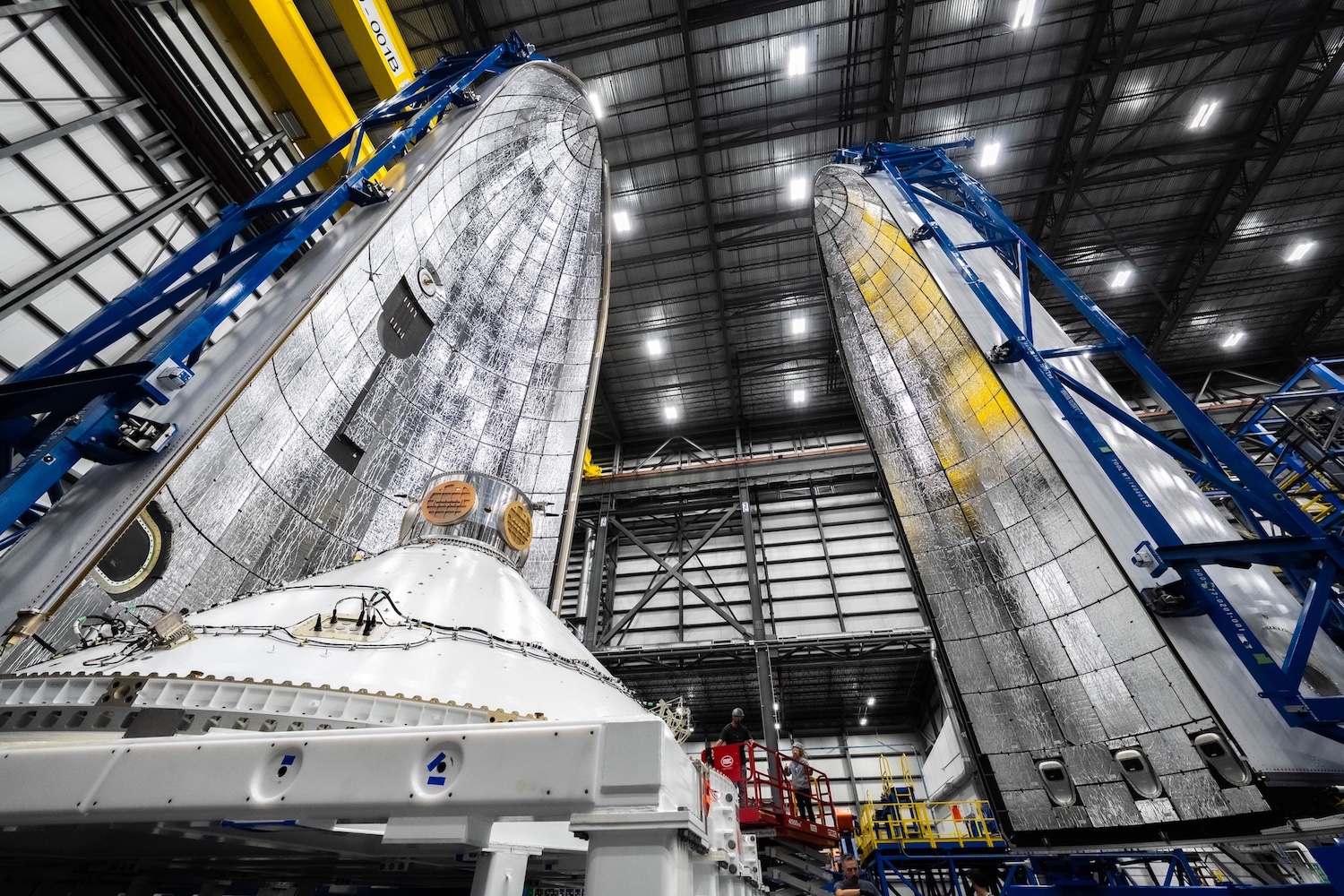
Blue Origin prepared the long-delayed New Glenn heavy-lift rocket for its first orbital attempt. The vehicle pairs a reusable methane-fueled first stage with a large fairing and years of government and commercial commitments. For Blue Origin, orbit would mark a shift from engines, suborbital tourism, and development into a cadence business.
First flight is necessary and economically insufficient. Customers need predictable follow-on missions, refurbishment evidence, and schedule options. New Glenn’s value also lies in supplier diversity for NASA and national security, so it need not immediately beat Falcon 9’s price. It must become available often enough that buying diversity is not buying delay.
New Glenn’s first mission had to establish more than orbital performance. The seven-engine methane booster, hydrogen upper stage, launch complex, mission software, range procedures, and recovery ship had never completed one flight together. Component tests reduce uncertainty; integration creates new interfaces. A clean countdown is a systems result before ignition.
The vehicle’s large fairing and reusable first stage targeted national-security, commercial, and exploration payloads. Blue Origin needed to prove schedule credibility after years of delay. Customers can tolerate a new rocket’s risk when launch alternatives exist, but they cannot design missions around a provider whose date remains aspirational. Debut success buys technical evidence; repeated availability buys a market.
Landing the booster was valuable and secondary to reaching orbit. A new launcher should not protect recovery hardware at the expense of payload insertion. Recovery systems add guidance, reserve propellant, ship operations, and refurbishment. The first stage can fail to land while the launch service succeeds. Keeping those objectives separate makes early flights informative rather than all-or-nothing.
Blue Origin’s vertical assets—engines, factories, launch sites, and a wealthy owner—gave it unusual patience. They also increased organizational surface area. BE-4 engines served ULA’s Vulcan as well as New Glenn, so delays propagated across companies. A supplier that is also a launcher must allocate hardware and engineering attention among internal and external programs.
The credibility test would continue after orbit. Payload integration, manifest stability, turnaround, and the second flight matter more to customers than a ceremonial first. Aerospace history contains successful debuts followed by long gaps. New Glenn needed a production line whose learning did not depend on rebuilding the team around every vehicle.
New Glenn's engineering debt is easiest to see at the interfaces. Seven BE-4 engines must start, throttle, and shut down inside a narrow timing envelope; the stage must survive ascent without a flight history; and the ground system has to load methane and oxygen repeatedly without turning every scrub into a multi-day reset. A successful first orbit proves the interfaces met once. Credibility begins when the same process survives different payloads, weather, and hardware serial numbers.
Recovery changes the design optimum even before a booster is reused. Landing hardware consumes dry mass and ascent performance, while reserve propellant reduces what reaches orbit. The return is a stage whose tanks, engines, avionics, and structure can be inspected rather than discarded. Blue Origin should publish which components drove refurbishment work and how predicted loads matched measured ones. Reuse becomes economic when inspection shrinks toward planned maintenance, not when a spectacular landing merely preserves an expensive article.
The customer test is schedule elasticity. A heavy launcher earns its place when it can absorb a delayed payload, exchange missions, and return to the pad without a bespoke recovery campaign. That requires spare engines, transport fixtures, trained shifts, range slots, and a launch site that behaves like production infrastructure. Payload mass to orbit is one output; the more important early output is a bounded distribution of days between ready-to-fly vehicles.
Space infrastructure
Starship practices becoming a truck
SpaceX said Starship’s next test would deploy ten simulator satellites representing the next generation of Starlink. Payload deployment tests the door, dispenser, attitude control, and operations that turn a giant vehicle into transportation. A rocket that reaches space but cannot reliably release customer hardware is a very energetic research program.
Starlink is the ideal captive payload. SpaceX can accept test risk, design satellites around the vehicle, and create internal demand for cadence. Vertical integration shortens feedback but can also make external customers secondary to the company’s constellation. The mock satellites were ballast with a job: demonstrate that the rocket is learning logistics.
Carrying ten Starlink simulators was a test of payload deployment mechanics rather than a revenue mission. The upper stage needed to open its payload door, manage dynamics, and release objects without collision. A truck is not useful because its engine runs; it must load, protect, and unload cargo into the correct place.
Starlink V3 satellites were expected to be larger than Falcon 9’s common payloads, tying constellation growth to Starship capacity. Vertical integration supplied an internal customer willing to accept developmental schedule and vehicle risk. SpaceX could design satellite and dispenser around the rocket simultaneously, a feedback loop third-party customers cannot match.
Deployment changes vehicle control. Releasing mass shifts center of gravity and imparts small reaction forces. Multiple satellites need separation timing so their trajectories diverge safely. Doors, hinges, and ejectors must survive launch and operate after thermal exposure. A stuck payload can convert a successful ascent into no useful mission.
Mock satellites let the company test shape and mass without risking production spacecraft. Telemetry can validate loads and separation; cameras provide evidence. The limitation is fidelity: simulators do not reproduce every flexible mode, connector, software handshake, or failure of real flight hardware. Qualification advances by increasing resemblance until the payload is too valuable to call a test.
Starship’s economics depended on high-volume cargo, and Starlink depended on cheap high-volume launch. This circularity was strategic rather than suspicious if each side delivered value. It also made company forecasts correlated. A delay to upper-stage reuse or deployment affected broadband capacity and the cash flows expected to finance further rocket development.
A tower catch replaces landing legs with a precision guidance and ground-mechanism problem. The vehicle must null lateral velocity and attitude near structures while propellant sloshes and engines operate in their least forgiving regime. Navigation error, wind, engine-out behavior, arm motion, and communications latency share one closing geometry. The mechanism saves mass only if its abort logic prevents a marginal approach from destroying the launch infrastructure needed for the next flight.
Truck-like operation is a configuration-management claim. Each Starship flight changes engines, tiles, software, propellant loading, or ground hardware, so apparent cadence can outrun comparability. Engineers need a genealogy that maps every observed anomaly to the relevant serial numbers and build state. Fast iteration works when a failure teaches the next vehicle; it fails when several vehicles were already frozen with the same unrecognized defect.
Payload customers care about environments and probability, not the number of dramatic test objectives. Acoustic load, vibration, contamination, orbital insertion error, deployment reliability, and schedule variance determine whether an instrument can be insured and planned. A reusable transport system becomes infrastructure when users can design against published envelopes and choose a launch window with a believable confidence interval. Catching hardware is an enabling milestone, not the service-level agreement.
AI economics
The $200 user can still be too enthusiastic
Sam Altman said OpenAI was losing money on ChatGPT Pro because subscribers used the service more than expected. A flat monthly price transfers usage risk to the provider. That works when heavy and light users average out; it fails when the plan specifically attracts people with expensive reasoning workloads.
The admission illustrates why AI pricing keeps drifting toward credits, rate limits, and differentiated compute. Users want the option to ask anything without metering; providers need marginal revenue to track GPU time. Unlimited plans are marketing devices built on a statistical assumption. Power users treat the assumption as a challenge.
A $200 monthly plan bundled access to compute whose marginal cost varied by user. Most subscribers would use far less than the cap; a small group could send long reasoning tasks, large contexts, and repeated generations. Flat-rate pricing depends on that distribution. When power users arrive specifically because the plan advertises generous access, adverse selection erodes the subsidy.
Inference cost includes prefill over input tokens, decoding output one token at a time, memory occupied by the key-value cache, and opportunity cost on a scarce accelerator. Reasoning models add hidden tokens and longer occupancy. A user’s visible answer can be short while the serving work is large. Message limits are a crude proxy for a workload with wide variance.
Subscriptions reduce billing friction and make revenue predictable. Usage pricing aligns cost and discourages exploration. Hybrid plans include a generous allowance, priority tiers, and metered overage. The product must tell users enough about consumption to avoid surprise without exposing every internal token. ‘Unlimited’ becomes a trust liability when the system quietly throttles.
Heavy users can still be economically valuable. Their tasks reveal demand at the capability frontier, produce feedback, and may become enterprise contracts. Losing money on an early plan can be customer acquisition or research expense. It becomes a problem if the company cannot separate valuable usage from automated loops that consume resources because they are bundled.
Altman’s admission was useful because it punctured software intuition. Popularity did not automatically improve margin. The next model might be more capable and costlier per request, while optimization lowered unit cost. Pricing had to evolve with both curves. The product team was running an insurance pool over human curiosity.
A low monthly price changes who can run a frontier model and also changes the provider's queueing problem. Heavy users generate long contexts and reasoning traces whose marginal GPU time can exceed the subscription margin. The service can respond with rate limits, priority tiers, cached computation, or hidden effort controls. Those controls define the real product. A benchmark produced at maximum inference budget may not describe the model a subscriber receives during peak demand.
Enthusiasm becomes operational risk when users delegate irreversible work before reliability is measured. The assistant may draft code, move data, or synthesize financial conclusions with the same fluent surface across known and unknown domains. A useful client separates proposal from execution, records tool calls, limits credentials, and requires confirmation at material boundaries. Cheap cognition makes oversight more important because the number of attempted actions rises faster than human review capacity.
The economic counterforce is substitution. If several labs offer good-enough reasoning, customers can route by price, latency, privacy, or tool support rather than stay loyal to one leaderboard leader. Providers then differentiate through distribution and integration, which can make switching harder even as raw inference becomes cheaper. The $200 plan is therefore both a margin experiment and a bid to establish habits before model capability becomes broadly interchangeable.
Markets
The launch scoreboard becomes industrial data
Payload’s count of 2024 orbital attempts showed the US leading on the back of SpaceX cadence, China sustaining a large program, and a long tail of national providers. Launch counts measure more than national prestige. Each successful attempt supports suppliers, ranges, regulators, insurers, and a workforce that retains operational memory.
The metric needs context: one heavy mission is not equivalent to one small launch, and Starlink flights are partly internal demand. Still, repetition changes cost and reliability. A country can announce a launcher; an industry emerges when components are ordered again before the previous invoice cools.
Orbital attempts by country revealed manufacturing and demand, not merely national ambition. The United States led largely through SpaceX cadence; China sustained a broad launch base; other countries had smaller programs and emerging vehicles. A launch is the visible tip of engines, stages, pads, ranges, suppliers, payloads, and licenses that all cleared a date.
Counting attempts rewards frequent small vehicles and treats partial failures ambiguously. Mass to orbit, successful spacecraft deployed, reuse, unique customers, and schedule delay give different pictures. There is no neutral scoreboard. The chosen metric should match the question: industrial throughput, access, reliability, or scientific value.
Cadence compounds learning. Repeated operations expose weak procedures, allow batches, and keep teams practiced. Suppliers invest when orders recur. Customers trust a manifest with several alternate slots. One launch slipping does not reset the year. This organizational redundancy is harder to copy than a vehicle drawing.
Internal constellation demand made US totals exceptional. China’s planned megaconstellations could create a similar anchor. Europe’s institutional missions and sovereign-access goals supported a smaller cadence. Markets with no large recurring payload faced a chicken-and-egg problem: rockets needed demand and satellite businesses needed dependable rockets.
The annual tally was a lagging indicator of capital allocated years earlier. New entrants would appear slowly; failed ventures would leave skills and facilities for acquisition. The interesting number for 2025 was not how many rockets had been announced. It was how many production systems could replace a delayed vehicle without losing the next customer.
A launch total compresses several distinct production systems. One operator may fly a standardized internal constellation, another may process unrelated customer spacecraft, and a third may count suborbital or test missions. Comparisons should separate vehicle families, payload ownership, successful orbital insertions, and recovery attempts. Otherwise vertical integration looks like pure launch productivity when part of the cadence comes from controlling both sides of the manifest.
Industrial learning appears in dispersion, not only averages. Track days from stage acceptance to launch, scrub causes, pad turnaround, engine removals, and the gap between planned and actual windows. A falling median can coexist with a worsening tail if a few missions consume extraordinary engineering attention. Customers price the tail because one six-month slip can overwhelm savings from a cheap nominal launch.
The scoreboard also creates incentives to game the denominator. Rideshares, deployments, launches, and payloads answer different questions; counting whichever grew fastest obscures capacity. A better public ledger reports delivered mass and orbit, customer type, schedule performance, vehicle configuration, and mission outcome. With that data, cadence stops being social-media theater and becomes evidence about factories, ranges, and operational resilience.
New Glenn needs cadence, Starship needs payload operations, ChatGPT Pro needs usage discipline, and national launch systems need repetition. Capacity becomes valuable only when matched with demand that neither overwhelms nor abandons it. The frontier’s recurring problem is not building the machine. It is teaching a market how often to use it.
All four systems can be described with queueing theory. Payloads wait for New Glenn. Starlinks wait inside Starship. Pro subscribers wait for accelerators. National missions wait for pads and ranges. Increasing peak capacity helps only if arrival rate, service time, and recovery from failure remain balanced.
Utilization creates an uncomfortable optimum. Too low and fixed assets never earn their cost. Too high and one anomaly propagates into months of delay. Clouds keep reserve capacity, airlines keep spare aircraft, and mature launch systems need hardware and schedule margin. Frontier firms often call every idle unit waste until the first failure reveals it was resilience.
Vertical integration can supply demand and reduce coordination: Starlink fills Starship, OpenAI owns the model and subscription, Blue Origin owns major components. It can also hide transfer economics. A launch price charged to an internal constellation and compute cost allocated to a subscription are management choices. External customers eventually test whether the integrated system clears a real market.
The meaningful scale metric is recovery time. How quickly does the next rocket fly after an anomaly, the next deployment proceed after a jam, the service absorb a demand spike, or the launch calendar reroute a payload? Production is not a machine repeating ideal cycles. It is an organization returning to cadence after the cycle that was not ideal.
2025 began with impressive capacity and thin evidence about sustained throughput for several systems. That is the right place for skepticism to sit. The question was no longer can the hardware work once. It was whether customers could plan around it without learning the names of everyone in the control room.