Frontier MechanicsField report / 023
Frontier Mechanics Week 23: New Glenn reaches orbit, Starship breaks up, Stoke raises, and the FTC maps cloud power
Two giant rockets produced opposite headlines, a smaller reusable launcher financed patience, and regulators described model partnerships as control without ownership.
Blue Origin’s New Glenn reached orbit on its first flight. Hours later, Starship’s upper stage broke apart during its seventh test and scattered debris over the Caribbean, while Super Heavy completed another tower catch. Stoke Space raised $260 million for a fully reusable smaller rocket. The FTC also published findings on cloud companies’ partnerships with AI labs.
Success and failure shared a week because launch programs are distributions, not verdicts. Corporate control is becoming a distribution too: capital, compute, and exclusive rights can shape a company without buying it.
New Glenn reached orbit and missed its booster landing. Starship caught Super Heavy and lost the upper stage. Stoke raised $260 million for a vehicle designed to reuse both stages. The FTC described cloud–model partnerships as channels of control. The week made partial success impossible to avoid. Complex systems cross several thresholds per attempt, and institutions prefer one label. Engineering learns from the vector: ascent, staging, orbit, recovery, disclosure, dependency. Markets and regulators eventually need the same resolution.
Launch
New Glenn clears the first line
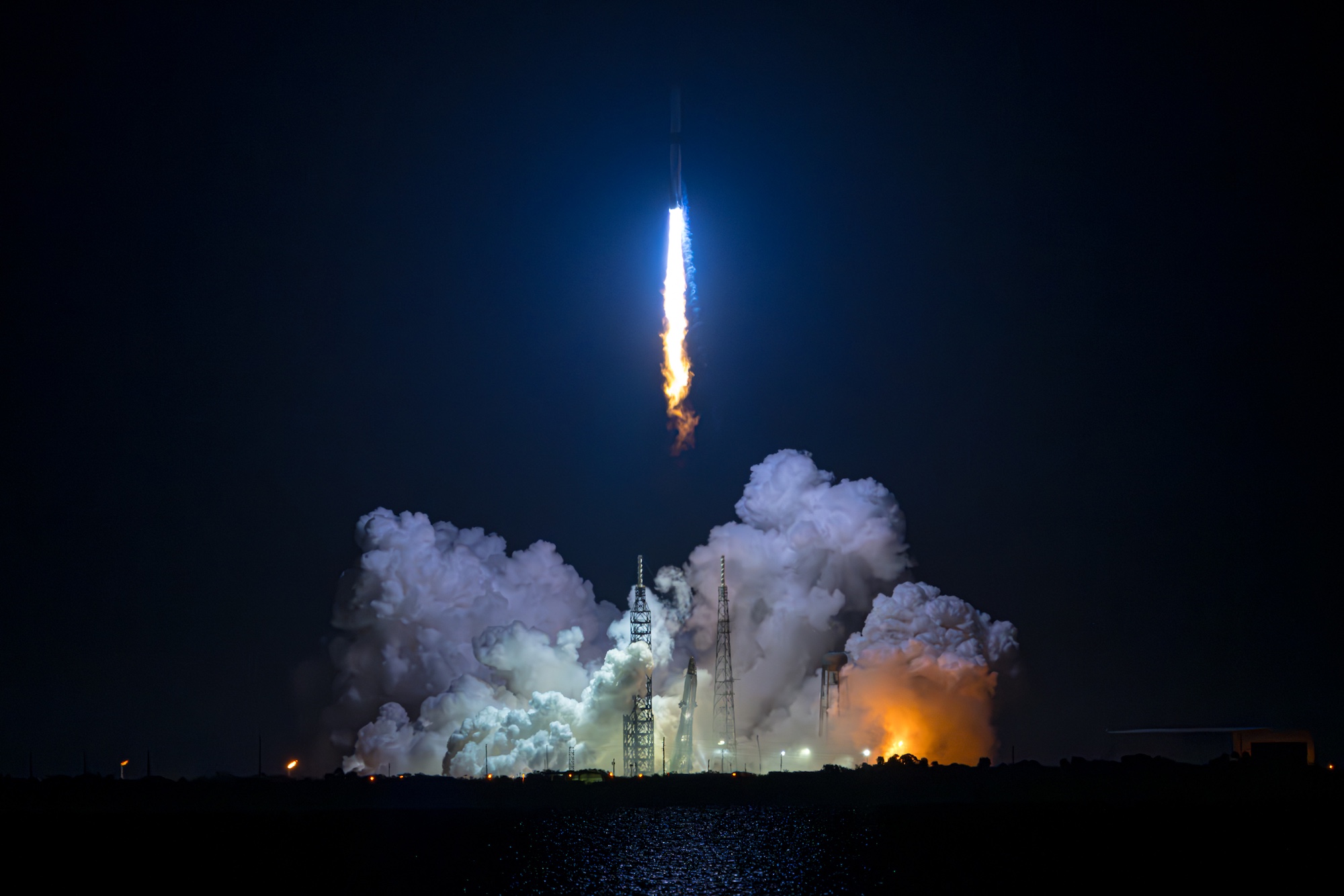
New Glenn reached orbit on January 16 carrying Blue Ring Pathfinder, although the first-stage recovery attempt failed. Reaching the intended orbit on a maiden flight validated the core vehicle, BE-4 propulsion stack, and ground operations. Missing the booster landing preserved the distinction between an orbital rocket and an economically reusable one.
Blue Origin now needs cadence. Customers tolerate first-flight uncertainty in exchange for access or strategic diversity; they price repeated delays differently. The successful ascent gives the manifest something real to organize around. Recovery data gives the next flight a concrete problem. Rocket development is generous that way: even success delivers homework.
New Glenn’s NG-1 mission delivered the Blue Ring Pathfinder to orbit, validating launch operations, BE-4 ascent, stage separation, and the hydrogen upper stage. The booster did not land on the recovery vessel. For a debut, orbital insertion was the primary service. Recovery failure affected the cost roadmap, not the payload’s achieved state.
Seven BE-4 engines had to start and operate together under loads never reproduced exactly on the ground. The upper stage’s BE-3U engines used hydrogen for efficient vacuum performance, introducing cryogenic handling and restart considerations. A successful interface between stages retired a different risk from engine operation.
Blue Origin attempted recovery on the first flight because data and organizational focus were valuable, even if probability was modest. The landing profile required entry and landing burns, navigation to a moving ship, and reserve propellant. Failure location and telemetry would determine whether the fix was guidance, propulsion, structures, or operations.
Reaching orbit qualified New Glenn for a market conversation; national-security certification and customer trust required more flights. Insurers price demonstrated history. Launch manifests respond to schedule evidence slowly because payload integration begins long before a mission. One flight shifts probability, not category.
The vehicle enlarged US heavy-lift capacity and reduced dependence on one provider in principle. Diversity becomes real when a second rocket has cadence and available slots. Strategic value justified patience beyond immediate commercial margin. The next launch date mattered almost as much as NG-1’s orbit.
First flight data closes models that ground tests can only approximate. Tank pressurization, propellant settling, engine interaction, structural modes, stage separation, and thermal environments occur as a coupled trajectory. The most valuable telemetry is often not a nominal measurement but the residual between prediction and flight. Those residuals decide whether qualification margins were conservative, accidental, or insufficient for the next mission.
A recovered booster would add inspection data, but an expendable or lost stage can still teach through high-rate sensing. Engineers correlate strain, acceleration, temperatures, valve positions, and guidance commands to a configuration-controlled vehicle. Sensor failures and missing packets must be included rather than silently removed. A launch system becomes more credible when it can explain anomalies and update uncertainty, not when every plot is postprocessed into nominality.
The second flight is the statistical beginning. It tests whether procedures, supplier parts, and workmanship reproduce the first outcome. Watch pad turnaround, engine acceptance, corrective actions, and payload accommodations more closely than a repeated liftoff image. New Glenn clears a line when the organization can deliver another vehicle on a bounded schedule with fewer exceptional workarounds.
Flight test
Starship wins the catch and loses the ship
Starship Flight 7 ended when the upper stage broke up after propellant leaks and fires, creating debris that disrupted air traffic. The booster returned for a successful tower catch. One integrated test therefore proved an extraordinary ground-recovery operation and exposed a serious upper-stage failure.
The FAA required an investigation because experimental tolerance does not transfer risk to uninvolved aircraft and communities for free. SpaceX’s iteration model depends on flying enough to find failures; public legitimacy depends on containing them. Fast learning and external safety are not opposing philosophies. They are constraints the test program has to satisfy simultaneously.
Starship Flight 7 caught its booster and lost Ship after an apparent fire developed in the aft section. The debris produced airspace disruption across the Caribbean. One mission advanced first-stage recovery and exposed an upper-stage failure. Calling the flight a success or failure without qualifiers discarded the information the test program existed to collect.
The upper stage introduced a new-generation design with increased propellant volume and changed systems. Hardware upgrades reset parts of the reliability history. A test vehicle that looks similar can contain new plumbing, avionics, and thermal behavior. Iteration speed creates learning and configuration management risk when several builds overlap.
A fire after ascent can result from leaks, component failure, vibration, or thermal interaction. Telemetry must locate timing and correlated sensor changes, while recovered debris may be limited. The company can reproduce conditions in ground tests and alter design. A public explanation should distinguish confirmed cause, leading hypothesis, and corrective action.
Airspace consequences made failure external. Launch hazard areas cover planned debris; an unplanned breakup can reroute commercial aircraft and raise international concerns. Higher cadence requires regulators and aviation systems to integrate launch uncertainty without imposing unlimited closures. External disruption belongs in the cost of test.
The repeated booster catch demonstrated learning on one branch. Rapid reuse still depended on inspection and reflight of a caught booster, while upper-stage survival remained the gating path for full economics. Development can be modular, but customer missions need the whole vector to meet minimum success.
A booster catch and an upper-stage loss can be simultaneously meaningful because reusable launch has separable reliability domains. The catch validates navigation, engine relight, propellant reserve, structural capture points, and tower control. The ship failure tests ascent propulsion and thermal or structural margins elsewhere. Treating the flight as one binary hides which hypotheses survived and which vehicle configuration must change.
Repeated failure classes are where rapid iteration faces its hardest criticism. If an anomaly shares physical origin with a previous one, the question is not whether hardware changed but whether the causal model improved. Corrective action should trace requirement, analysis, design change, qualification test, and monitored flight signature. A visible alteration without a closed causal chain risks moving the failure rather than eliminating it.
The tower is also a common-mode asset. A vehicle accident can damage arms, tanks, plumbing, or the launch mount and stop the entire program. Recovery logic therefore needs conservative divert and destruct envelopes that protect both public safety and future throughput. The apparent bravery of a close catch should be judged against expected days of infrastructure downtime, not spectacle.
Startups
Stoke finances both stages
Stoke Space raised $260 million to continue Nova, a medium-lift vehicle designed for full reusability. Its distinctive second stage uses a ring of small thrusters around an actively cooled heat shield, seeking a stage that can survive reentry and land without discarding the most orbitally capable hardware.
Second-stage reuse is harder than booster reuse because orbital velocity dominates heating and energy. Stoke’s design integrates propulsion and protection, which may reduce parts and creates tight coupling: the same system must launch, shield, and land. The round buys testing before revenue. Investors are wagering that SpaceX proved the destination while leaving room for a differently sized vehicle to find a route.
Stoke’s Nova pursued full reuse with a distinctive upper-stage heat shield and engine architecture. Recovering the second stage is difficult because orbital velocity creates severe heating and because an upper stage must carry recovery hardware all the way to orbit. Stoke treated reuse as a first-principles design input rather than a feature added after payload performance.
Its actively cooled metallic heat shield was integrated with a ring of small thrusters in the upper-stage base. Regenerative cooling could manage reentry heat and support landing propulsion. The architecture reduces fragile tiles and creates many engines, plumbing paths, and control interactions. Robustness depends on manufacturing and fault tolerance.
Full reuse promises lower marginal hardware cost and fast turnaround. It reduces payload through dry mass and propellant reserved for landing. The business needs sufficient flight rate to amortize development and refurbishable hardware. A fully reusable rocket flying rarely can cost more per mission than a partially reusable incumbent with a full manifest.
The $260 million round funded engine tests, structures, launch-site work, and regulatory progress before orbital revenue. Rocket financing arrives in milestone tranches because technical risk and capital need are both large. Investors price not only probability of flight but survival until a market still needs the vehicle.
Stoke’s opportunity was a medium launcher with responsive service and more complete reuse than competitors. Its risk was arriving after SpaceX, Rocket Lab, and others expanded capability. Architecture can be elegant and the market too crowded. Speed to credible flight heritage is part of vehicle performance.
Full reusability couples two demanding vehicles. The first stage must return through dense atmosphere; the second must survive orbital velocity heating, manage on-orbit propellant and power, then land with enough reserve. Each kilogram of recovery hardware subtracts from payload, while reliability improvements may require additional sensors and redundancy. Stoke's architecture succeeds only if repeated use lowers total cost faster than these penalties reduce delivered performance.
Financing must bridge a discontinuous sequence of evidence. Engine firings, stage tests, hopper flights, orbital attempts, recovery, and reuse each retire different risk, and failure at one gate can require redesign capital before revenue. Investors should map cash to technical milestones with schedule distributions rather than a single first-launch date. A large round buys optionality only if the company knows which experiment will invalidate its most expensive assumption.
The second stage is the differentiator and the schedule trap. Reentry protection, reusable fairing functions, payload access, and landing propulsion occupy the same mass and geometry. Ground demonstrations cannot fully reproduce coupled aerothermal loads. Stoke should preserve incremental commercial value—engine or stage learning, government testing, perhaps expendable capability—so the company is not financially binary on recovering both stages immediately.
Competition policy
Partnership is a form of control
The FTC warned that cloud partnerships with AI developers could create lock-in, privileged access, and influence through compute commitments and equity rights. Microsoft–OpenAI, Amazon–Anthropic, and Google–Anthropic are not simple acquisitions. They can still align product roadmaps and make a lab dependent on one provider’s infrastructure.
The labs gain billions and scarce compute; clouds gain workloads and a claim on the model layer. Customers may gain faster products while losing independent suppliers. Antitrust law is accustomed to ownership as a bright line. AI partnerships distribute control across contracts, credits, board rights, and technical dependence. The regulator is learning to read the architecture diagram as part of the cap table.
The FTC studied partnerships among major cloud providers and AI developers, including investment, compute agreements, governance rights, and exclusivity. These arrangements stopped short of full acquisition and could still influence competition. A cloud supplied scarce compute, received equity and preferred distribution, and gained information about a model company’s plans.
Control can exist through dependency. A model lab with multibillion-dollar cloud commitments cannot switch quickly even if contracts permit it. Technical optimization, data location, safety tooling, and enterprise marketplace distribution reinforce the tie. Formal independence does not eliminate economic leverage.
The partnerships also solve genuine coordination. Training requires capital and reserved infrastructure; clouds need anchor demand; joint engineering improves efficiency. Prohibiting them could entrench only the labs able to self-finance. Competition analysis should examine restrictive terms and access, not assume collaboration itself is anticompetitive.
Information rights matter. A cloud investor may learn product roadmaps, costs, or demand that affect how it supports competing customers or builds its own models. Firewalls and governance limit misuse but are hard to audit. The platform is simultaneously supplier, investor, distributor, and competitor.
Regulators faced a market moving faster than merger review. Talent licenses and minority investments transferred capability without a conventional acquisition. The useful test was substantive: who controls scarce resources, key personnel, model access, and strategic decisions? Corporate labels are inputs, not answers.
A partnership can transfer control through defaults instead of ownership. Exclusive cloud capacity, model access, distribution placement, revenue shares, and intellectual-property licenses determine which party can bargain later. The nominally independent partner may remain unable to serve another customer or move workloads without rewriting its stack. Governance analysis should read termination, portability, and capacity clauses as closely as valuation.
Compute commitments are particularly binding because they convert a strategic relationship into physical infrastructure. Datacenters, accelerators, and networking are ordered years ahead; model training then adapts to what was purchased. If demand or architecture changes, the supplier may hold leverage over scarce substitutions. Multi-cloud rhetoric matters less than whether checkpoints, data pipelines, and serving systems can actually migrate within a known cost and time.
The counterargument is that deep coupling creates genuine efficiency. A lab and platform can co-design kernels, safety systems, and products faster than arm's-length vendors. The test is whether efficiencies are specific and measurable or merely justify foreclosing alternatives. Partnership becomes healthy control when duties, audit rights, and exit paths are explicit enough that both sides can invest without pretending dependence does not exist.
New Glenn, Starship, Stoke, and the cloud labs are all vertically coupled systems. Coupling can make performance possible and failure contagious. The sensible response is not to eliminate dependence; rockets and models cannot be assembled from independent slogans. It is to know where the coupling sits, what fails with it, and whether anyone outside the system gets a vote.
A system result is a vector, but capital and policy demand scalar decisions. Fund or do not. Certify or do not. Permit or do not. Regulators and boards need summaries, while engineers need the dimensions preserved.
Milestone design bridges those needs. A launcher can earn payment for orbit separately from recovery; a funding round can release capital after engine and stage tests; a partnership can allow compute cooperation without governance rights. Decompose the outcome before the test and partial success becomes actionable rather than rhetorical.
Partial success can also become an excuse. Companies emphasize the completed dimension and postpone the one tied to economics. Investors should ask whether the failed line is independent or whether it invalidates the business model. Orbit without landing may be acceptable on flight one; a decade of expendable ‘reusable’ missions is a different product.
The FTC’s work belonged beside the rockets because partnerships are also multi-stage vehicles. Capital launches the lab, cloud carries it, enterprise distribution deploys it, and governance determines recovery when interests diverge. A relationship can work technically and fail competitively.
The most mature sentence in frontier engineering is not it worked. It is these parts worked under these conditions, these did not, and the next allocation follows from the difference.