Frontier MechanicsField report / 088
Frontier Mechanics Week 88: Cerebras opens the wafer-scale books, Ising learns the QPU, New Glenn saves the booster and loses the orbit, and Rosalind Franklin regains a path to Mars
An S-1 exposed the economics behind giant silicon, Nvidia put neural networks into quantum control, reuse diverged from mission success, and a transatlantic rescue rewired a rover.
Four systems exposed what they depended on this week. Cerebras filed an S-1 around wafer-scale computers. Nvidia released models for quantum calibration and decoding. New Glenn refl flew a booster successfully while its upper stage delivered BlueBird 7 too low. NASA approved implementation of its contribution to ESA's Rosalind Franklin rover.
The dependence is the story: one large customer, continuous calibration, independent rocket stages, and international replacement hardware. Technical depth begins where the system stops being described as one object.
Scale broke familiar accounting units this week. Cerebras made a wafer the chip. Ising made decoding latency part of a quantum machine. New Glenn split launch success from reuse success. Rosalind Franklin split a science mission from the supply chain that once enabled it. Each story needed at least two scorecards.
AI hardware
Cerebras replaces the reticle boundary with a yield problem it can route around
Cerebras filed its registration statement on April 17, giving public investors a view into a company built around the Wafer-Scale Engine. Instead of cutting a silicon wafer into many packaged dies, Cerebras keeps most of the wafer as one processor, linking hundreds of thousands of compute cores with on-wafer memory and fabric.
A conventional chip is limited by lithographic reticle size and package I/O. Clusters cross package, board, and rack links, paying energy and latency to move model state. Wafer-scale integration leaves more communication on silicon. It also encounters defects across an enormous area. Redundant cores and routable fabric allow the system to bypass bad regions rather than demanding a flawless wafer.
The architecture is strongest when a workload maps onto distributed local memory and predictable communication. Large sparse models and scientific stencils can benefit; arbitrary software does not automatically do so. Compilers must partition tensors, schedule communication, and keep cores occupied. The software stack determines whether physical bandwidth becomes useful throughput.
The S-1 makes customer concentration, capital equipment, supply agreements, and service revenue visible. A machine can lead a benchmark while the business depends on one buyer or expensive deployment terms. Investors should separate gross token throughput from utilization, pricing, support obligations, and the cost of installed systems.
Going public gives Cerebras capital and a recurring disclosure clock. That can improve technical accountability if filings expose orders, concentration, and product transitions. Wafer-scale engineering is a genuine architectural bet; the market now gets to see whether its economic surface area is as coherent as the silicon.
Conventional chips are patterned as repeated reticles and cut into dies, discarding defective units. A wafer-scale processor keeps a huge fabric connected and routes around defective cores and links. Yield becomes a topology problem: enough good resources and paths must remain to meet a product bin. Packaging, power delivery, and cooling scale across an area no ordinary socket expects.
The architectural gain is local communication. Model parameters and activations can move across the on-wafer fabric without paying some off-chip bandwidth and network overhead. Large workloads still require many systems, and memory capacity or model fit can determine whether the advantage holds. Benchmarking must include compilation and scaling, not only a kernel that maps ideally.
Public-market diligence should connect technical differentiation to gross margin and customer concentration. Wafer-scale systems require specialized manufacturing, packaging, cooling, and service. If a small number of customers or one foundry dominate, demand and supply risk remain coupled. The S-1 matters because it lets readers test whether performance converts into repeatable economics.
Cerebras replacing the reticle boundary creates a wafer-scale system where defects cannot be avoided by discarding one bad die. Redundant cores and interconnect route around faults, turning yield into a mapping problem. Power delivery, clocking, cooling, packaging, and thermal expansion across the wafer become equally important constraints.
On-chip memory and fabric can reduce model communication compared with clusters of separate accelerators. The advantage depends on workload fit and compiler ability to partition operations around defective resources. Large models may still require multiple wafers and external memory, reintroducing network bottlenecks. Benchmarks need complete training or inference jobs under production fault maps.
Manufacturing economics includes accepted wafer systems, custom cooling, serviceability, and utilization. One failed subsystem should degrade capacity rather than disable an expensive module. Cerebras' design is compelling because it embraces defects architecturally; the product is proven when routing keeps performance predictable across the natural variation of manufactured wafers.
Quantum control
Ising turns quantum error correction into a real-time inference workload
Nvidia released the open Ising model family on April 14 for quantum-processor calibration and error-correction decoding. Ising Calibration uses a vision-language approach to interpret measurement plots and suggest adjustments. Ising Decoding uses three-dimensional convolutional networks to infer likely errors from syndrome data.
Physical qubits drift. Frequencies, pulse amplitudes, crosstalk, readout thresholds, and couplers require repeated calibration, often through expert interpretation of sweeps. Automating that loop can increase available experiment time. But an agent must recognize out-of-distribution hardware behavior and avoid confidently tuning a device into an unsafe or uninformative region.
Error correction repeatedly measures parity checks without directly measuring encoded quantum information. The resulting syndrome has spatial and temporal structure; a decoder must identify a likely error chain before the logical computation proceeds. Accuracy and latency trade off. A better decoder is useless if it cannot keep pace with the code cycle.
Nvidia reported faster and more accurate decoding than a common matching baseline on selected tests. The comparison needs hardware-specific noise, scaling, tail latency, and compute-power accounting. Neural decoders can learn correlated noise but may degrade when the device changes. Continuous calibration of the decoder becomes another control problem.
Ising is strategically clever because useful quantum computers require substantial classical compute even when quantum hardware improves. Nvidia is not waiting to sell a QPU. It is making GPUs and models the control plane around one. The open release will matter if laboratories can reproduce gains on their own noise rather than a benchmark distribution.
Quantum error correction repeatedly measures syndromes that indicate likely errors without directly measuring the encoded state. A decoder must infer corrections before noise and control cycles outrun it. This is a streaming inference workload with hard latency and throughput requirements, not an offline algorithm waiting for a convenient GPU batch.
Ising-style methods map decoding into an optimization landscape, but the complete system includes syndrome extraction, transport, classical preprocessing, solver convergence, and delivery of a correction or frame update. Tail latency matters because one slow round can accumulate further errors. Average throughput can hide the event that breaks the logical qubit.
A useful benchmark varies code distance, physical error rate, correlations, and hardware faults, then reports logical error and latency distributions. It should compare specialized and conventional decoders at equal system boundaries. The decoder is part of the quantum computer's control plane; success is measured by longer logical computation, not elegance of the optimization mapping.
Quantum error correction turns decoding into a real-time inference workload: measurements produce syndromes, and a classical algorithm estimates likely errors before the next control decision. Decoder latency must stay below the correction cycle while accuracy handles correlated and drifting noise. A theoretically optimal decoder that arrives late is wrong operationally.
Ising formulations can map error patterns to energy minimization, but hardware embedding, communication, and readout add overhead. Comparisons should include end-to-end latency and logical error under the same syndrome stream as optimized classical decoders. Synthetic noise should be supplemented with device traces containing leakage and bursts.
The workload scales with code size and qubit count, creating a classical compute and wiring budget near the quantum machine. Co-design can choose codes and decoders matched to hardware. Success is a lower logical error at required cycle time and power, not a better solution to an abstract Ising instance after the qubits have already moved on.
Launch systems
New Glenn proves that reuse and delivery are independent columns
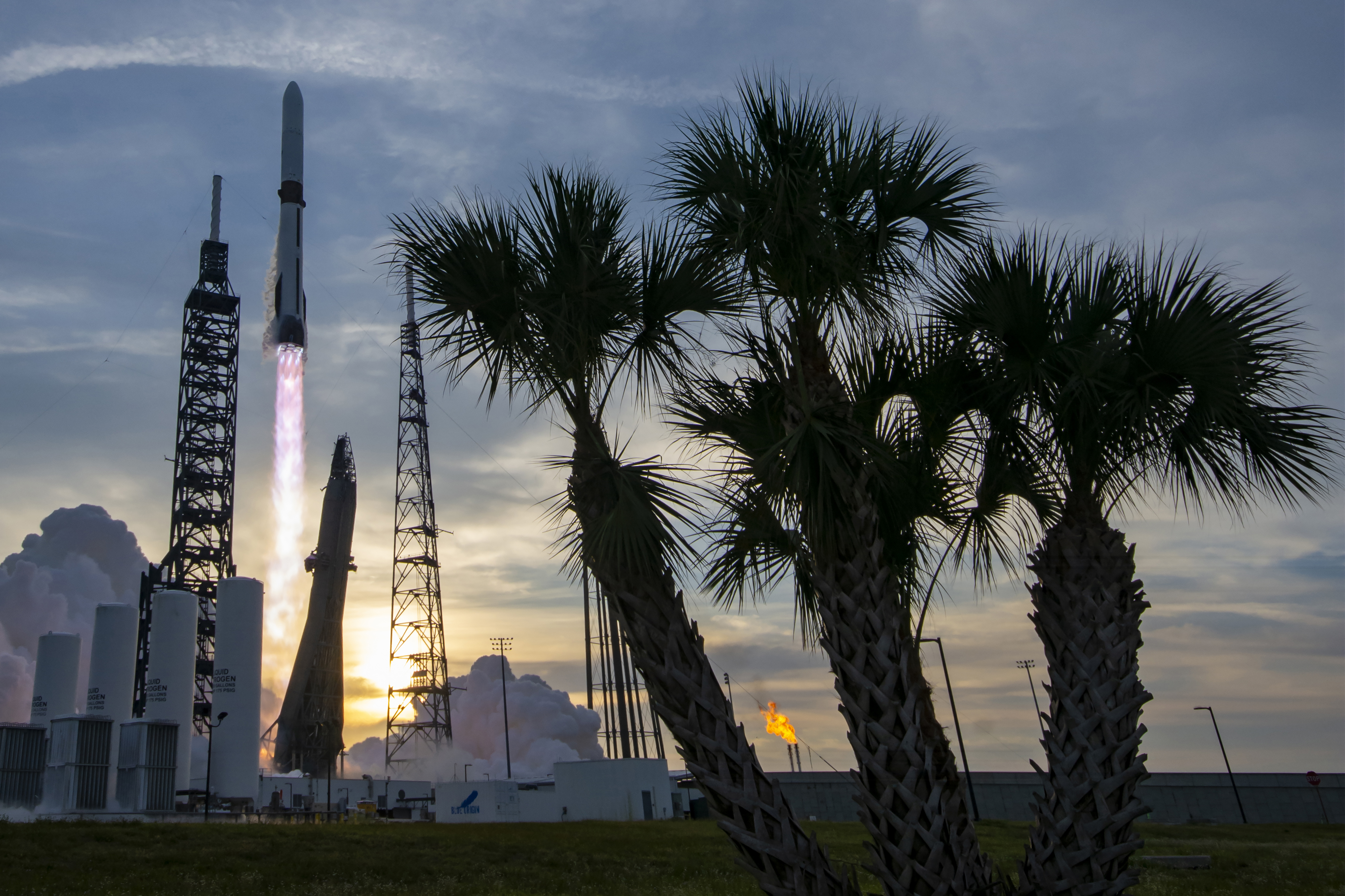
New Glenn launched BlueBird 7 on April 19 and successfully refl ew and landed its first-stage booster. The upper stage did not place the satellite into its required orbit, leaving it too low for operations. One mission therefore produced a major reuse achievement and a failed customer outcome. Both statements must remain true.
A launcher's first stage supplies most liftoff thrust and returns from lower energy than the upper stage. Reuse validates engines, structures, thermal protection, guidance, and refurbishment across flights. It can lower marginal cost and expose life limits. It does not reduce the precision demanded of upper-stage ignition, mixture control, guidance, and orbital insertion.
BlueBird satellites unfold very large arrays for direct-to-device communications. Their orbit and attitude plan is constrained by deployment, power, link geometry, and atmospheric drag. A low insertion cannot always be repaired: onboard propulsion may lack thrust or propellant, and operating before deployment may be impossible. Payload robustness has limits set by mass.
The split result complicates reliability accounting. A provider can celebrate booster objectives while a customer records a total loss. Launch contracts, insurance, and public statistics need mission-success categories that preserve partial achievements without confusing them with delivered service. Reuse matters economically only when payload delivery remains reliable.
The failure is also a test of cadence. Blue Origin needs enough flight and ground data to find the upper-stage cause without treating the recovered booster as proof the system is mature. A reusable rocket is two learning loops: hardware that returns and payloads that arrive. The company advanced one and owes evidence on the other.
New Glenn's mission separated three outcomes: payload delivery, booster recovery, and learning. The booster reportedly re-flew and landed, establishing reuse of named hardware; the upper-stage or mission sequence failed to place the payload as intended. Calling the launch simply successful or failed collapses independent engineering chains.
Recovery evidence can still improve economics if the booster is inspected and flies again. Yet customers buy orbit, so upper-stage reliability and mission assurance dominate service value. Management must prevent the visible triumph of a landing from diverting investigation resources or public attention from delivery failure.
The next proof is asymmetric: another landing does little to close the payload risk, while an expendable configuration could test delivery without reuse. Blue Origin needs corrective evidence on the failed chain and refurbishment evidence on the recovered one. A reusable launch business is multiplication—reliable delivery times repeatable hardware—not an average of two scorecards.
New Glenn proving reuse and delivery in separate columns keeps mission and fleet economics honest. Payload insertion can succeed even if recovery fails; landing can succeed on a test mission whose upper stage misses orbit. Customers need delivery reliability, while Blue Origin needs recovered condition and turnaround. Combining them hides which value proposition advanced.
The columns interact through reserve propellant, trajectory, weather, and range. A recovery attempt may reduce performance or constrain mission profile. Commercial service needs rules for when customer delivery takes priority and how recovery risk is priced. Telemetry should connect each choice to margins.
Over time, the scorecard should add refurbishment hours and repeat flight by serial. A recovered booster sitting in a hangar has option value, not proven savings. Reuse becomes production when delivery reliability remains high while the same fleet accumulates cycles and fewer extraordinary inspections.
Mars exploration
Rosalind Franklin replaces a geopolitical dependency with new hardware
NASA approved implementation of the Rosalind Franklin Support and Augmentation project on April 16, formalizing hardware and services for ESA's 2028 Mars rover mission. The contributions include a U.S. launch vehicle, landing-platform propulsion, radioisotope heater units, and portions of the Mars Organic Molecule Analyzer.
The mission was reconfigured after cooperation with Russia ended. Replacing a launch and landing contribution is not a procurement substitution. Interfaces, mass properties, software, qualification evidence, and schedules change. A propulsion system shapes the descent trajectory and structural loads; heater units affect thermal design throughout cruise and surface operations.
Rosalind Franklin's drill is designed to reach roughly two meters below the surface, where organic molecules may be better shielded from radiation and oxidants. Samples move through a chain of mechanisms into an analytical drawer. Planetary protection and contamination knowledge matter because trace organics from Earth can look more convincing than Mars.
MOMA uses mass spectrometry and complementary chemical techniques to identify molecules. Wet-chemistry reagents can derivatize less volatile compounds for analysis, but each cup is finite and every thermal step can transform the sample. Operations must choose where to spend consumables based on incomplete geological context.
The rescue illustrates the hidden value of modular international programs: partners can reassign work when politics changes. It also shows the cost. Every new interface must be reverified against a launch date set by planetary alignment. Cooperation is not merely diplomacy around a rover; it is part of the rover's fault tree.
Replacing a Russian landing platform changes mass, power, interfaces, descent dynamics, software, and test responsibility. Rosalind Franklin's rover may be scientifically mature while the mission around it becomes partly new. Heritage transfers only where conditions and interfaces remain equivalent.
The replacement program must protect the rover from schedule-driven requirements growth. Clear interface control, early drop and thermal tests, and incremental integration reduce the chance that a late lander issue propagates into science hardware. Planetary protection also spans the full assembly and landing chain, so new facilities and partners must preserve contamination control.
NASA participation can restore technical capacity and political durability, but transatlantic governance adds review and export boundaries. A joint mission needs one configuration authority and unambiguous anomaly ownership. The path to Mars is credible when responsibilities are attached to hardware and tests, not simply distributed across agency logos.
Rosalind Franklin's replacement hardware must reproduce interfaces designed around a prior dependency: mass, power, data, thermal, mechanical, and software behavior. Substitution after design maturity can ripple through qualification. The new component needs margins that keep the rest of the rover from being reopened unnecessarily.
Geopolitical independence has schedule and performance costs. A domestic or allied supplier may lack flight heritage, while continuing with the original path may be impossible. Parallel test articles and interface simulators can accelerate learning. Documentation must preserve why the old design made choices so replacement teams do not rediscover constraints through failure.
The mission should report technical readiness and remaining critical path separately from political commitment. New hardware can improve resilience for future programs if its production and knowledge survive one rover. Dependency replacement is successful when the resulting capability becomes a reusable European option, not a one-time workaround.
Cerebras, Ising, New Glenn, and Rosalind Franklin were all systems whose headline object concealed a supporting network. The network became visible through a filing, a decoder, an insertion failure, or a geopolitical rupture.
Redundancy is not having two of the same thing. It is preserving a path when one assumption breaks: routing around a wafer defect, recalibrating a qubit, separating stage evidence, or replacing an international contribution.
This week the frontier advanced by showing where it could bend—and where it still snapped.
Scale creates composite outcomes. A routed wafer can work despite defects, a decoder can be fast but logically ineffective, a booster can land while a payload misses orbit, and a rover can be ready while its transport is not.
Week 88 demanded separate scorecards connected by one system model. That is less satisfying than a binary verdict and much more useful for deciding what has actually been de-risked.