Frontier MechanicsField report / 094
Frontier Mechanics Week 94: Vera becomes an agent CPU, robots get 29-digit IDs, New Glenn destroys a pad, and Meta sketches a pendant
Nvidia optimized the host around tool-using workloads, China attached lifecycle identity to humanoids, a hotfire became a full-stack loss, and ambient AI tried a body smaller than glasses.
The week ran from systems architecture to debris. Nvidia unveiled its Vera CPU and full-production Vera Rubin platform. China introduced a national 29-digit identity system for humanoid robots. A New Glenn vehicle exploded during an integrated hotfire. A Meta memo pointed toward an AI pendant.
All four stories concerned persistent identity: a process moving across cores, a robot moving across owners, a launch vehicle whose configuration must be reconstructed after loss, and an assistant moving through a person's day. Identity sounds abstract until a system needs continuity, blame, or recovery.
Identity and coordination ran through the week. Vera coordinated heterogeneous agent workloads. China's robot identifier linked machines to records. New Glenn's pad test linked a ground event to flight confidence. Meta's pendant linked ambient observation to a person and place. Each system needed a durable answer to: what exactly produced this action or signal?
Data-center hardware
Vera treats the CPU as the traffic controller for agent work
Nvidia unveiled Vera on May 31 as a custom data-center CPU for agentic workloads, sold in standalone servers and as part of Vera Rubin racks and storage systems. The pitch is that agents run code, invoke tools, manage contexts, and move data in patterns that place more pressure on general-purpose processing than a pure accelerator benchmark reveals.
GPU kernels dominate dense tensor operations, but an agent workflow also performs tokenization, retrieval, serialization, sandbox management, networking, database access, and scheduling. Low accelerator utilization can come from host stalls and small irregular tasks. A CPU designed around memory bandwidth, I/O, and tightly coupled fabrics can increase end-to-end throughput without changing the model.
Vera's real moat is rack architecture. NVLink scale-up, Ethernet or InfiniBand scale-out, BlueField data processing, storage, and software define where bytes travel and which processor owns them. A fast core inside a congested memory hierarchy does not produce more tokens. Nvidia is optimizing the data center as one computer.
The 'CPU for agents' label should be tested against workload traces: concurrent sandboxes, tool latency, memory footprint, utilization, energy, and tail response time. Agents are not one instruction mix. Coding, search, simulation, and enterprise workflows have different host behavior. A general CPU must avoid being overfit to today's orchestrators.
Vera matters strategically because Nvidia is moving from accelerator supplier toward complete system designer. Customers gain integration and lose substitution. The platform earns its premium if measured work per rack and operator time improve enough to offset that dependency.
An agent platform creates many irregular tasks: token generation, retrieval, code execution, memory operations, network requests, and safety checks. The CPU coordinates these accelerators and I/O paths. If it cannot feed data, schedule work, or isolate tenants, GPU utilization falls despite enormous arithmetic capacity. Control-plane latency becomes model latency.
Vera's design should be evaluated at the node level. Memory bandwidth, coherent links, network processing, virtualization, power, and software determine how many useful agent trajectories complete per rack. A fast CPU benchmark can miss the contention created when thousands of agents wake tools or access vector stores at once.
Agents also expand the security surface. Each tool call carries credentials and untrusted data; the CPU and operating system enforce process boundaries before an accelerator sees a tensor. Confidential computing, memory protection, and audit logs are workload features, not enterprise add-ons. The orchestrator is valuable because it can be the narrow place where permissions become machine-enforced.
Vera treats the CPU as traffic controller because agent work mixes model inference, retrieval, tool calls, networking, and state updates. Accelerators handle dense computation; CPUs schedule irregular tasks, parse results, enforce permissions, and feed devices. A starved host can leave expensive GPUs idle while aggregate accelerator utilization appears mysterious.
The scheduler needs priorities and backpressure. Interactive requests, long agents, and batch jobs have different latency objectives. Tool calls may block on remote systems and should release scarce compute without losing state. Memory and network locality determine whether orchestration overhead dominates small model calls.
Benchmark complete workflows per rack and watt, including host cores and failed retries. Better CPU orchestration can increase useful inference without changing the model. The architecture wins when it turns heterogeneous resources into predictable service and exposes which queue, rather than which chip, limits the next request.
Robotics governance
A robot's 29-digit ID is a database schema for responsibility
China unveiled a national digital-ID system for humanoid robots on May 28, assigning each machine a 29-digit code intended to follow its full lifecycle. More than 100 companies and 28,000 units across 200 models were reported in the system. The identifier connects a physical body to records about manufacture, deployment, and status.
A persistent identity can bind firmware versions, safety certificates, maintenance, component changes, incidents, and ownership. That helps distinguish two visually identical robots whose actuators or models differ. It also supports recalls and fleet analytics. The value comes from authenticated updates to the record, not the length of the number.
The security model is delicate. If a robot can spoof another ID, suppress a fault, or be cloned after a control board replacement, the database creates false confidence. Hardware-backed keys and signed logs can link identity to controllers, while repair procedures need legitimate re-enrollment. A sealed identity would make maintenance impossible.
Privacy and labor surveillance are equally real. A lifecycle platform can record where a machine works and what software it runs; if interaction logs are attached, it may expose workers and homes. Data minimization, access roles, retention, and appeal should be part of the standard. Traceability can protect a user or centralize observation.
The program shows how quickly robotics is becoming a regulated fleet rather than a set of prototypes. Cars, aircraft, and medical devices already carry serial histories. Humanoids will too. The frontier question is who can read and write that history—and whether the robot's owner can take it elsewhere.
A 29-digit robot identifier can encode manufacturer, model, unit, and other registry fields, but an identifier is useful only if it resolves to trustworthy records. Ownership, software version, maintenance, certification, and incident history change over time. The registry needs authentication, update rules, and privacy boundaries.
Physical marking must survive dirt, damage, part replacement, and network loss. A machine-readable code can be copied; a secure hardware identity can fail; remote lookup can be unavailable. Layered identification may combine visible labels, cryptographic credentials, and local records. Operators need a graceful way to establish minimum identity during an emergency.
The system can enable recalls, insurance, fleet management, and accountability, while also enabling tracking and surveillance. Access controls should distinguish a nearby worker checking safety status from a regulator investigating an incident or the public querying ownership. A long number is a schema decision whose governance will matter more than its length.
A 29-digit robot ID can encode manufacturer, model, serial, component or jurisdiction, but meaning should live in a versioned registry rather than the digits themselves. Identity needs to connect the physical machine to firmware, owner, operator, maintenance, and certificates across transfer. A label that can be copied is not authentication.
Responsibility is event-specific. The manufacturer may own a hardware defect, the deployer the workflow, the operator an override, and the model provider an update. Logs need trusted time, configuration, and action provenance so investigators can reconstruct which actor controlled the relevant boundary. Privacy rules should limit tracking of robots whose work reveals people.
Interoperability requires global uniqueness, offline readability, revocation, and replacement after damaged modules. The schema should avoid centralizing all operational data in one registry. The ID is useful when a safety report, service part, or software update resolves to the exact affected fleet without exposing everyone else's activity.
Launch testing
New Glenn's hotfire shows why a ground test can be a mission
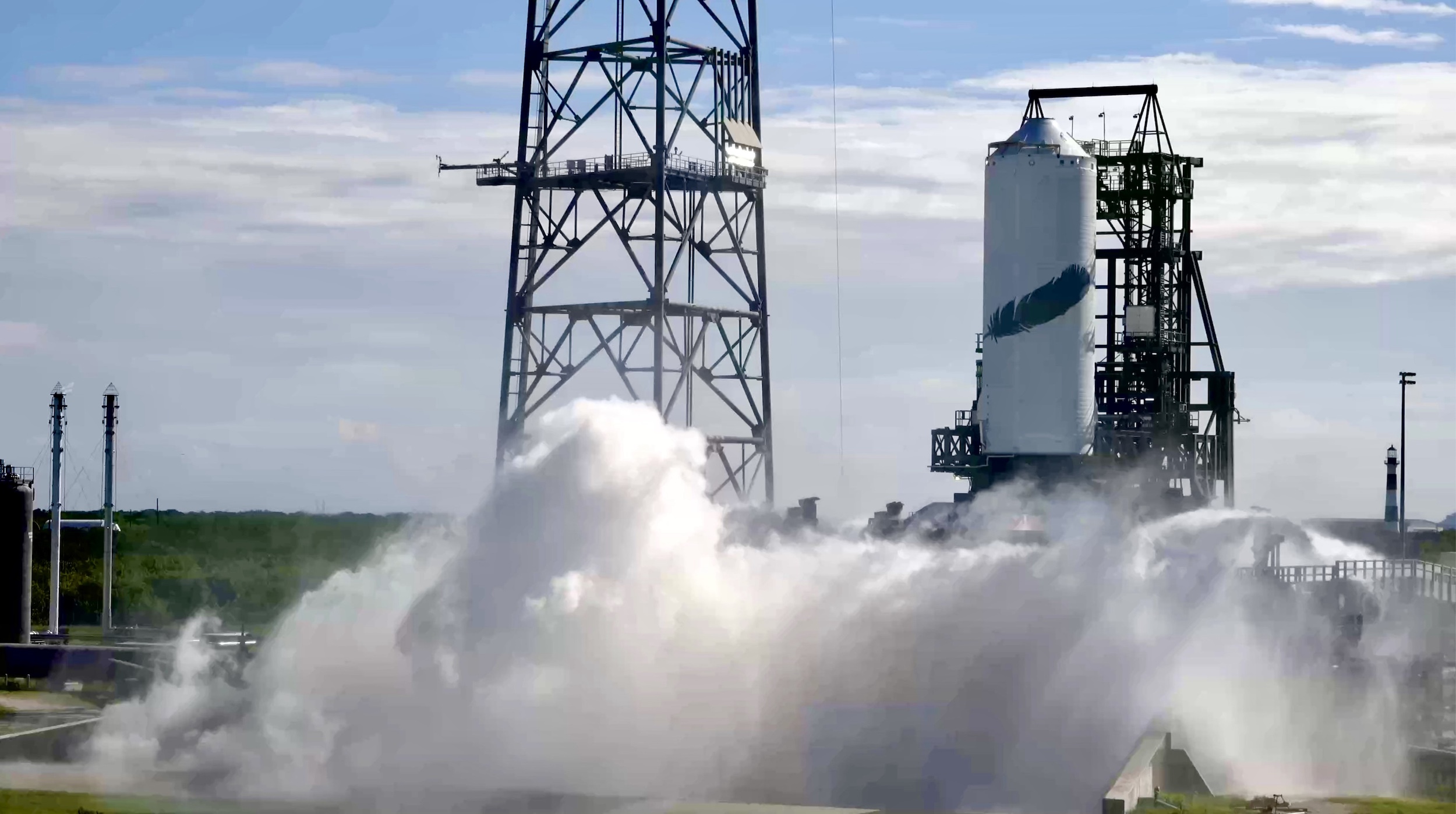
A New Glenn integrated vehicle exploded during a hotfire at Launch Complex 36 on May 28. No one was injured, but the vehicle and major pad infrastructure were lost. The test followed an April upper-stage failure and was preparing a return-to-flight mission. A static firing had concentrated flight energy inside the facility.
An integrated hotfire loads cryogenic propellants, pressurizes tanks, exercises ground systems, starts engines, and validates shutdown while restraints hold the vehicle. It tests interfaces that component stands cannot: vehicle plumbing, sequencing, software, acoustic loads, and pad equipment. It also prevents the rocket from moving away if energy release becomes uncontrolled.
Methane and oxygen can accumulate through a leak or failed ignition, and confined mixtures can transition from fire to rapid pressure. Root cause cannot be inferred from a video plume. Investigators need valve commands, pressures, temperatures, ignition timing, imagery, debris, and configuration history—some of which may have been destroyed.
Pad damage often controls return time. Flame trenches, mounts, tanks, electrical rooms, water systems, and underground conduits are specialized long-lead assets. A spare rocket does not restore launch. Designing sensors and barriers so evidence and critical infrastructure survive becomes a lesson paid for by the first accident.
The event is not proof that hotfire testing was misguided. It is evidence of the risk the test was meant to expose before flight. The program now needs disciplined reconstruction rather than a fast narrative. Failure data is valuable only if schedule pressure is not allowed to edit it.
A static fire exercises engines, plumbing, propellant loading, hold-downs, software, and pad systems while the vehicle remains attached. It deliberately concentrates energy close to infrastructure. Sensors and abort logic must distinguish an expected transient from a condition that requires shutdown within milliseconds.
Pad damage can be valuable evidence if it reveals an underestimated plume, acoustic, thermal, or structural load before launch. It can also expose a test design that threatened adjacent systems unnecessarily. Investigation should map measured environments against qualification assumptions and determine whether the damage mechanism can affect the vehicle in flight.
Schedule pressure creates a temptation to call ground infrastructure expendable. Repeated operations need a pad whose inspection and repair cycle fits cadence. Blue Origin's response should therefore include both hardware correction and an operating model for detection, spares, and turnaround. A test succeeds when it protects the future flight program from the thing it discovered.
New Glenn's hotfire is mission-like because engines, stage plumbing, ground propellant, controls, hold logic, and pad structures operate together. Static conditions differ from flight backpressure, acceleration, and propellant dynamics, but the test can validate start sequence, thrust buildup, timing, vibration, and shutdown before payload risk enters.
Instrumentation turns fire into evidence. Chamber pressure, turbopump speed, valve state, strain, acoustics, and temperatures need synchronized clocks and expected envelopes. A test stopped by automation can be successful if it catches an unsafe divergence and preserves data. Duration alone says little about margins.
Ground tests also exercise team and reset. Inspecting the stage, servicing the pad, and determining next readiness are part of cadence. A hotfire becomes a mission when its procedures and configuration match flight closely enough that the result changes launch confidence—and when discrepancies cannot be dismissed because the vehicle never left the mount.
Personal hardware
Meta's pendant turns ambient context into a consent problem
Reporting on May 30 revealed a Meta memo describing an AI-powered pendant for testing in the following year. A pendant can carry microphones, cameras, inertial sensing, and local compute while remaining less visually obstructive than glasses. Its product value would come from persistent context rather than a display.
Persistent context is technically difficult. Always-on sensing must fit a small battery and thermal envelope, separate voices, determine when to record, and compress or discard data locally. Cloud inference improves models but adds latency, connectivity, and exposure. A useful device needs a hierarchy of wake detection, edge processing, and explicit capture.
The wearer is not the only data subject. Bystanders cannot inspect whether a pendant is listening or infer its retention policy. Visible indicators can be obscured, and consent varies by space and jurisdiction. Hardware should make recording state physically legible and provide modes that disable sensors below software.
Memory assistants also face epistemic drift. A transcript may be wrong, a summary may merge speakers, and retrieval can present an inference as a remembered fact. Provenance should link an answer to timestamped source segments and show uncertainty. Otherwise an ambient archive produces confident synthetic memory.
Meta has distribution, models, social identity, and wearable experience. That integration is why the device could work and why governance matters. The pendant's smallest component may be the visible object; the actual product is a database of daily life.
An ambient pendant can collect audio, images, location, and conversational context to provide memory or assistance. Unlike a phone raised intentionally, it observes by default. Bystanders may not know when sensing is active or where data goes. The physical design—lights, shutters, buttons, and microphones—is part of the consent model.
On-device processing can reduce raw-data upload, but generated summaries may reveal sensitive content just as effectively. Retention, enrollment, deletion, law-enforcement access, and household sharing need clear controls. Speaker recognition and face blurring are probabilistic; they cannot substitute for an obvious social cue and a way to stop capture.
The product's utility must exceed the burden it places on everyone nearby. A narrowly scoped memory aid with explicit activation may earn a norm; continuous ambient collection may cause exclusion from workplaces and homes. Meta should test not only wearer satisfaction but bystander understanding and behavior. Consent is a system outcome, not a privacy-policy paragraph.
Meta's pendant turns ambient context into a stream containing bystanders, location, conversations, and routines. Consent cannot be obtained through the wearer's account alone. Hardware should visibly signal capture, support local processing, and minimize retention. A microphone or camera that is always available creates social cost even when the model activates selectively.
Context improves assistance by linking names, tasks, and moments, but it also creates surveillance and inference. The system may derive relationships or health information nobody explicitly stated. Permissions need data type, place, person, and purpose, with easy deletion and a mode that remains useful when sensing is off.
The product test is whether assistance justifies the negotiation burden around it. Measure useful interventions, false activations, bystander complaints, and data exposure. Ambient AI becomes acceptable when its state is legible to everyone in the room and the device can forget as deliberately as it remembers.
Vera, digital IDs, a hotfire record, and a pendant all required continuity across events. Persistent systems need names, logs, and a way to tell one configuration from another.
Identity is useful because it makes history attachable. It is dangerous because history becomes controllable by whoever owns the registry.
This week machines acquired longer memories. The governance question is whether their users did too.
Identity gives coordination a place to attach. A workload, robot, test configuration, or recording device needs a provenance trail before its outputs can be trusted or challenged.
Week 94's danger was identification without governance. Naming an object is easy. Keeping its history authentic, appropriately visible, and connected to responsibility is the actual infrastructure.