Frontier MechanicsField report / 110
Frontier Mechanics Week 110: IonQ rearranges a solver, Caelora sells the lasers, StriX measures a moving Earth, and the Fed raises the cost of waiting
A quantum-assisted engineering benchmark worth reading past the headline, a fusion company's laser business, radar in a dedicated orbit, and the financing consequences of a rate increase. Reporting for September 14-20, 2026.
A faster simulation is valuable even if the quantum computer only touches a small part of it. A laser can find paying customers before the fusion plant it was designed for exists. A radar satellite can measure motion without delivering a photograph anyone would recognize. Some of the most useful engineering businesses live one layer below the result that gets the headline.
This week, IonQ offered a particularly good reason to inspect that layer. Its engineering-simulation announcement mixes a real hardware experiment, larger simulated circuits, and best-case improvements that deserve different labels. Marvel Fusion launched a laser subsidiary, Rocket Lab delivered another Synspective satellite, and the Federal Reserve increased its policy rate. The common question is practical: what has to happen around a promising component before the customer gets the promised outcome?
Quantum computing / engineering software
IonQ improves the ordering, not the laws of numerical analysis
IonQ and Synopsys announced engineering-simulation acceleration of up to 14.6 percent on September 17. The underlying paper is older, first submitted in March and revised in August. September's event is the announcement, not the invention of a new algorithm that week. The experiment applies quantum-assisted graph partitioning to an early stage of sparse-matrix ordering in LS-DYNA. Most of the engineering computation remains classical. That small intervention is precisely why the result is worth examining: a solver can spend a great deal of time paying for a poor ordering decision made near the beginning.
A structural model turns geometry, material behavior, constraints, and loads into equations. Discretization gives a matrix whose nonzero entries reflect which degrees of freedom interact. A node in a mesh generally has local neighbors, so the original matrix is sparse. During factorization, however, eliminating one variable can create connections between others. Those new nonzeros are called fill. They consume memory and arithmetic even though they were absent from the original physical discretization. Reordering variables does not change the underlying problem, but it can substantially change the work required to solve it.
Nested dissection looks for a relatively small separator that divides the interaction graph into pieces. Solve the pieces recursively and handle the separator later. An appealing separator is not simply the fewest cut edges: balance, downstream fill, and the eventual numerical workload matter. The research coarsens the graph, applies a quantum optimization step to the first partition, and refines the result classically. Think of it as spending extra effort on an early organizational choice whose consequences repeat throughout the solver. It is not a quantum computer directly simulating an entire vehicle's mechanics.
The distinction between physical and simulated quantum execution matters here. The paper reports experiments on IonQ Forte hardware with 36 qubits, alongside larger noiseless matrix-product-state simulations on classical GPUs. The headline 14.6 percent improvement is the best Drill result using a simulator; the best physical-hardware Drill result is about 12 percent. Results select the best of twenty candidate partitions, and the baseline uses LS-DYNA's internal partitioning path. The examples also use restricted simulation runs, not an observed seven-day production job finishing a day early. That longer-run saving is an extrapolation.
None of this makes the work uninteresting. It changes what the evidence establishes. A better separator can deliver a measurable downstream benefit. The next question is whether this particular way of finding it beats other ways given comparable budgets. If one method gets twenty attempts and another gets one, some improvement may come from search effort rather than the substrate doing the search. A useful follow-up would compare tuned classical coarse-graph optimizers, equal candidate counts, and equal elapsed preprocessing time. It should also show the distribution of solver outcomes, not only the winning candidate.
Amortization can rescue a relatively expensive preprocessing step. Suppose, purely as an illustration, an alternative ordering adds ten minutes of preparation and saves two minutes each time a factorization is repeated. It breaks even after five repetitions, before accounting for operational overhead. If the matrix structure changes and the ordering must be regenerated, the opportunity shrinks. If many load cases reuse the structure, it grows. A buyer needs that workload-specific accounting, including queueing and data movement, rather than a percentage detached from the number of times the useful decision is reused.
There is also a reliability question hidden inside best-of-many optimization. Can a team identify the best partition cheaply before running the expensive job? A proxy such as edge cut may not perfectly predict factorization time. Running every candidate through the full workload to discover the winner can consume the savings. An effective production system needs either a good predictor or a search budget whose cost is justified by the eventual run. That requirement applies equally to quantum and classical candidates; it is a property of the engineering workflow, not a criticism unique to qubits.
I would read this as a useful hybrid-software result with an open competitiveness question. The authors expose enough of the pipeline to ask meaningful questions about where the improvement originates. What they have not established is general quantum advantage over the best available classical approach. The most persuasive next release would make total wall-clock cost, baseline tuning, unsuccessful candidates, and representative long runs easy to inspect. Engineers do not need the quantum component to do everything. They need it to earn its place in a solver they already trust.

Photonics / industrial startups
Caelora gives a fusion company's lasers another customer
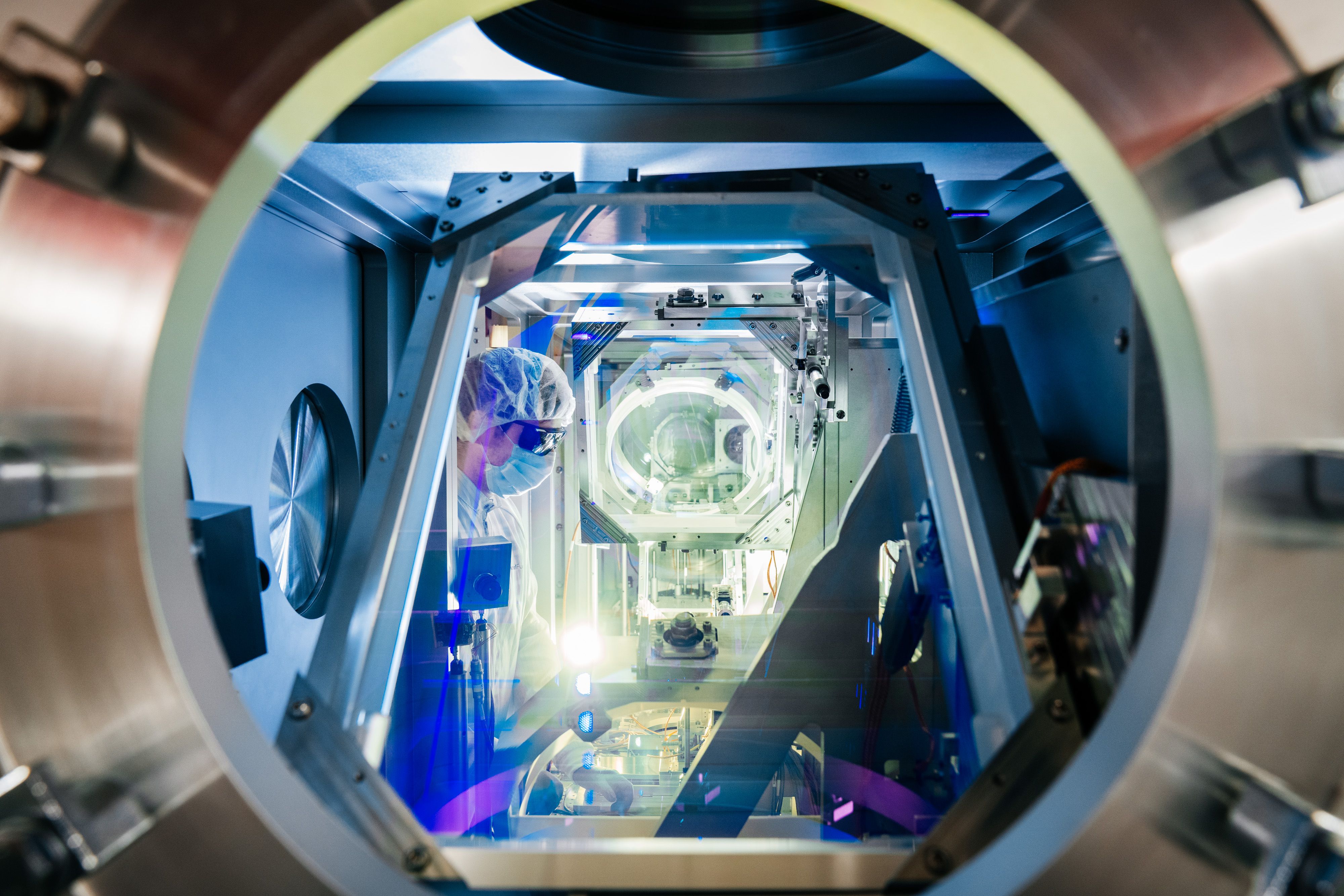
Marvel Fusion announced Caelora on September 16, a wholly owned Munich-based subsidiary led by Lutz Aschke. Its proposed business is diode-pumped laser technology for fusion and other applications, including science and radiation sources. The announcement also points to support through SPRIND's pulsed-laser technology program. This is a business-formation and commercialization announcement. It is not evidence that a fusion power station is operating, and a list of potential medical or industrial uses should not be read as a list of signed customers.
There is a sensible industrial argument underneath it. A fusion developer needs components that may have customers long before its complete energy system is ready. Selling those components can create revenue, manufacturing experience, and supplier relationships. It can also reveal requirements the original research program had little reason to prioritize: predictable maintenance, installation time, field service, and a machine that a customer can run without borrowing its inventors. The hard part is ensuring that the product those customers buy actually develops capabilities the fusion program needs, rather than becoming an unrelated custom-engineering shop.
Laser power needs more than one number. Peak power is roughly pulse energy divided by pulse duration. Average optical power is pulse energy multiplied by repetition rate. As a hypothetical example, a one-joule pulse lasting one picosecond has a peak power of one terawatt. Repeating it ten times a second produces ten watts of average optical output. Neither number tells you the electrical input, the fraction of energy arriving at the target in the desired spatial mode, or the time the system spends unavailable. A spectacular peak-power label can coexist with a modest duty cycle.
Increasing repetition rate changes the engineering problem. Heat has less time to leave the gain medium and optics between pulses. Temperature gradients change refractive index and distort the wavefront. A beam that was well behaved on an occasional laboratory shot may move, defocus, or acquire damaging intensity structure during sustained operation. Cooling, pump uniformity, coatings, optical cleanliness, and control loops become part of the delivered beam specification. The customer buys an operating envelope, not a single successful pulse. Lifetime under that envelope is often more commercially informative than a record measured once.
Wall-plug efficiency puts the same issue into an energy budget. If a hypothetical laser converts ten percent of its electrical input into useful optical output, delivering one kilowatt optically requires ten kilowatts electrically before auxiliary loads are counted. The remaining energy largely becomes heat that must be removed. For a scientific instrument, that may be an acceptable infrastructure expense. For a power-producing system, recirculating electricity competes directly with the electricity available for sale. Target gain alone cannot answer whether the complete plant exports useful power; the conversion chain and its parasitic loads have to be included.
Fusion adds a target-handling problem that a laser catalog cannot solve by itself. Repeated shots require targets with controlled geometry and composition, delivery to a precise location at the right instant, debris management, and a chamber that remains usable. The laser must synchronize with that process. An industrial radiation source may have a different target and much less demanding repetition or uptime requirements. This is why an adjacent sale is evidence of a particular capability, not automatic validation of the full fusion architecture. The overlap has to be specified rather than assumed.
A component subsidiary also creates an internal allocation problem. Outside customers want their own pulse shapes, wavelengths, interfaces, and delivery dates. The parent wants progress toward its energy system. Shared engineering can reduce cost, but priority disputes can consume the benefit. I would want to know which modules are standardized, which customer requests remain configurable, and which require a new design. A repeatable product with a controlled bill of materials teaches manufacturing lessons. A succession of bespoke laboratory installations may generate revenue while leaving unit costs and lead times stubbornly unchanged.
The useful milestones now are ordinary industrial ones: independently measured performance over long runs, service intervals, manufacturing yield, customer acceptance, and repeat orders. Those are less cinematic than a fusion shot, but they are hard to fake over time. Caelora gives Marvel Fusion a way to test whether part of its technology stack can survive a customer's procurement and maintenance process before the entire energy proposition is ready. That is a worthwhile experiment. Its success should be judged on the laser business's own evidence, with the contribution to fusion measured separately.
Space / radar measurement
Another StriX satellite buys geometry as much as coverage
Rocket Lab launched Owl By The Dozen at 03:22 UTC on September 19, carrying a Synspective StriX synthetic-aperture radar satellite to a planned 572-kilometer orbit inclined at 38 degrees. It was Electron's 96th mission and the twelfth launch for Synspective. The time conversion places liftoff late on September 18 on the US East Coast. The dedicated orbit matters: a constellation operator is buying a particular observation geometry and schedule, not simply a seat on whichever rocket has spare capacity.
Synthetic-aperture radar forms an image by transmitting microwave pulses and combining echoes collected as the spacecraft moves. Motion creates a long effective aperture, provided the processing preserves the timing and phase relationships needed to focus the returns. Unlike a conventional optical photograph, the data contain a complex signal: amplitude and phase. Brightness depends on geometry, surface roughness, moisture, and material response as well as the object's presence. A bright building edge is not interchangeable with a bright patch in a visible-light image. Interpretation requires knowing how the radar illuminated it.
Orbit inclination controls the latitudes the satellite can reach, while altitude, pointing limits, and acquisition planning help determine where useful observations can be made. More satellites can shorten opportunities between passes, but the benefit is uneven across geography and imaging mode. A dedicated launch lets the operator choose a slot that complements its existing fleet. That can be valuable even when a rideshare offers a lower price per kilogram. The economic unit is the observation a customer needs at a useful time, not the mass delivered to any acceptable orbit.
Radar interferometry makes the geometry even more demanding. Two coherent observations can be compared through their phase difference. In a simplified displacement interpretation, phase change is proportional to 4π times line-of-sight displacement divided by wavelength. The factor of two in the path comes from the outgoing and returning signal. Phase repeats every full cycle, so the observation is wrapped rather than an unlimited displacement ruler. Recovering a continuous field requires assumptions and processing, and the result measures motion along the viewing direction rather than all three spatial components independently.
That sensitivity is useful and inconvenient. A stable structure moving slightly can produce a detectable phase change. Atmospheric delay, imperfect orbit knowledge, topography, and changes in the scattering surface can also alter the measurement. Vegetation moving between acquisitions may destroy coherence. A construction site that changes dramatically may be easier to recognize in amplitude than to treat as a stable interferometric target. Multiple observations, reference points, and complementary viewing directions help separate effects, but they do not turn every pixel into a trustworthy displacement sensor by default.
For an infrastructure customer, revisit time is only one part of latency. A pass must be scheduled, data downlinked, processed, checked, and turned into something an engineer can act on. A warning arriving quickly but without uncertainty or a defensible reference frame may create more work than it saves. Conversely, a slower product with consistent calibration can be useful for tracking gradual subsidence. The service specification should say whether it promises acquisition opportunities, delivered scenes, validated measurements, or alerts. Those are different products with different operational responsibilities.
Consider a hypothetical operator watching an embankment. It wants a trend relative to a stable reference, an uncertainty estimate, and a way to distinguish a persistent change from one poor acquisition. A single colorful deformation map is insufficient. The operator also needs to know what happens when coherence drops or weather contributes a spatially varying delay. A credible service should mark missing or unreliable evidence instead of smoothing it into a reassuring picture. The difficult software work is often in refusing to make an unsupported measurement, not merely producing more pixels.
The launch therefore adds useful capacity without by itself proving any particular monitoring claim. Commissioning, calibration, acquisition planning, and delivery performance still sit between orbit insertion and customer value. I like dedicated small-launch missions most when this connection is explicit: a specific orbit improves a specific service enough to justify the launch choice. Synspective's repeated use of Electron makes the relationship worth following. The next numbers to inspect belong downstream of the rocket, where delivered coverage and measurement quality determine whether another satellite improved the business.
Markets / capital allocation
A quarter point changes which engineering delays are affordable
The Federal Reserve raised its target range by a quarter percentage point to 3.75-4 percent on September 16, with a unanimous vote. The statement described elevated inflation alongside strong productivity and robust investment. The implementation note set interest on reserve balances at 3.90 percent, effective September 17. Those are the week's policy actions. They do not tell us, by themselves, how much of the move was already priced into bonds or how any individual technology company's financing terms changed.
That distinction matters because markets respond to surprises and to the expected path, not simply to the direction of the latest vote. A rate increase that investors expected can coincide with falling longer-term yields if the accompanying information implies fewer future increases. A company issuing debt also pays a credit spread reflecting default risk, liquidity, and contract terms. Its financing cost is not mechanically the policy rate plus an immutable constant. Any claim that this meeting directly caused a particular market move would need evidence from prices and timing that the policy statement alone cannot supply.
There is still a straightforward engineering consequence to a higher required return: time becomes more expensive. The present value of a future cash flow is that cash flow divided by a discount factor that grows with the waiting period. In a deliberately simplified example, one dollar received ten years from now is worth about 46 cents at an eight percent annual discount rate and about 45 cents at 8.25 percent. A real startup valuation needs probabilities, multiple cash flows, dilution, and financing constraints. The example only isolates why distant returns are more sensitive to assumptions about the cost of capital.
Hardware businesses feel that timing through working capital as well as valuation. Components may be purchased months before delivery. A customer may pay only after acceptance. Inventory, work in progress, and receivables occupy cash while engineers resolve qualification or yield problems. A profitable unit on an income statement can therefore require substantial financing before it generates spendable money. Reducing a test cycle or negotiating a milestone payment can improve the business without changing the product's selling price. These operational details deserve attention alongside the more visible debate about terminal market size.
The interaction with technical risk is nonlinear. Suppose a team has enough cash for one qualification campaign but not for a second. A failed test does more than delay revenue by a few months; it may force a financing round at an unfavorable time or end the program. A schedule buffer, an earlier subsystem test, or a design that allows a cheap replacement can preserve options. This is why I dislike treating engineering contingency as automatically wasteful. Some extra spending buys information before the company commits its remaining capital to a configuration that cannot easily be changed.
Productivity complicates the macro picture in a useful way. Better tools can allow more output from a given set of inputs, but the transition may also demand factories, electricity, equipment, and skilled installation labor. A company can experience lower software costs and higher demand for scarce physical infrastructure at the same time. The policy statement's combination of productivity and inflation should therefore not be reduced to a slogan that AI either eliminates inflation or inevitably causes it. The timing, location, and substitutability of the constrained inputs determine which effect a particular business experiences.
For founders, the sensible exercise is scenario analysis rather than pretending to forecast the next vote. Model a slower acceptance schedule, a higher refinancing cost, and a customer stretching payment terms. Identify the point at which the company loses freedom to choose. Then ask which technical milestone most reduces that risk per dollar spent. An impressive demonstration that does not advance qualification may be less valuable than an unglamorous reliability test that unlocks a customer deposit. This is general capital-planning reasoning, not a recommendation to trade a security or a prediction of the next policy decision.
The connection to the other stories this week is concrete. A solver improvement earns money when it saves enough paid computing time. A laser subsidiary needs repeatable deliveries and manageable service costs. A radar constellation needs customers who pay for reliable measurements. Financing conditions change how long those businesses can wait for the conversion from technical result to cash. They do not decide whether the underlying science works. They do make it more important to know exactly which remaining experiment, production step, or customer decision stands between the two.
The IonQ result is more interesting after its caveats are visible, because the actual intervention becomes understandable. Caelora is more interesting when it is evaluated as a laser supplier rather than credited in advance with a power plant. StriX becomes more useful when its measurements carry the limitations of radar geometry instead of hiding them. Technical detail does not have to diminish a story; often it is the part that makes the story worth following.
For the next round of updates, I would watch total solver cost, repeat laser orders, and calibrated radar delivery. Those observations would tell us more than another round of ambitious headlines. In the meantime, the cost of waiting has moved again, and every team with a long development cycle has another reason to make its next test answer a question that actually matters.