Frontier MechanicsField report / 109
Frontier Mechanics Week 109: Maven takes the warehouse shift, Terran R enters NASA's catalog, ions remember a pulse, and connected products get a reporting clock
Industrial autonomy's operating hours, the meaning of a launch-services award, a gel that processes neural signals, and the first Cyber Resilience Act reporting deadline. Reporting for September 7-13, 2026.
A robot company says its machines are working multiple shifts. A launch company gets onto NASA's list of eligible providers. A laboratory builds a device in which ions retain a history of stimulation. Each has crossed a meaningful threshold, but the thresholds are not interchangeable. A financing round, a procurement vehicle, and an experiment answer different questions.
This week's most unusual hardware is the soft ionic device. Its attraction is that biological nerves already communicate through ions, so a material with controllable ionic dynamics might meet them on more compatible terms. The warehouse and rocket stories are more familiar, but their details matter just as much. We finish with a deadline that turns incident response into a product requirement for connected-device manufacturers selling into Europe.
Industrial robotics / startups
Maven's warehouse pitch has to survive the rest of the shift
Maven Robotics emerged publicly on September 10 with a $100 million Series A. The company says it has fleets operating autonomously across multiple daily shifts at a Fortune 250 consumer packaged goods customer. Its initial work includes mixed-case palletizing and tote handling. The announcement projects more than 100,000 autonomous operating hours by year-end and one million by the end of 2027. Those hour counts are targets, not totals already achieved.
Mixed-case palletizing sounds like a solved exercise until the boxes differ. The robot must build a stable load from packages with varying geometry, weight, crush resistance, and grasp surfaces. A placement that fits geometrically may leave a heavy case on a weak one, create an overhang, or obstruct the next grasp. The planning problem has memory: the quality of the current move depends on the stack already built and the cases still expected. Optimizing the next pick in isolation can create a bad pallet very efficiently.
Perception has to connect a catalog description with the particular object in front of the camera. Cardboard bends. Plastic wrap reflects light. Labels can be wrong or hidden. Two boxes with similar appearance can have different contents and mass. A practical system needs uncertainty estimates and ways to recover when the grasped object disagrees with the expected one. Force sensing, vacuum pressure, motion feedback, and inspection after placement can all contribute. A successful image classification is only one observation in that process.
There is also a distinction between a successful pick and a productive cell. Suppose, hypothetically, a robot completes 600 picks an hour when everything is flowing but loses twelve minutes to exceptions. Its effective rate is 480, before counting damaged goods or downstream blockage. Another machine with a 520-pick nominal rate and almost no interruption can win the shift. This is why demonstrations of rapid motion should be accompanied by distributions of cycle times and recovery times. The slowest incidents consume more of the economics than their frequency suggests.
Autonomous hours need a definition for the same reason. Does an hour count while the machine is waiting for material? How much remote assistance occurred? Were several machines simultaneously blocked by one upstream failure? Was a technician adjusting the cell between runs? None of these questions invalidates Maven's deployment claim. They identify the operating data needed to compare it with an alternative. A million hours spent across many easy, repetitive situations is different evidence from a smaller dataset covering the exceptions that cause most expensive stoppages.
Fleet learning can improve that coverage if the organization captures the right events. A failed grasp should retain the sensor context, object identity, attempted action, recovery, and final outcome. Otherwise the training system may learn that an intervention made the episode successful without learning why the original policy failed. Versioning matters too: a behavior observed on one gripper or software release may not transfer cleanly to another. The fleet is an experiment with changing instruments, and its logs need enough context to preserve that fact.
The buyer's integration problem extends outside the robot. Warehouse software releases work, conveyors deliver it, people replenish supplies, and downstream stations accept the result. If the robot becomes faster than its neighbors, queues move rather than disappear. A deployment can show a strong local utilization number while the facility's total output barely changes. The most persuasive economic trial measures completed, accepted work at the process boundary, then accounts for labor, floor space, maintenance, and the cost of exceptions throughout that process.
A vertically integrated company has a reasonable answer: own more of the system so hardware, policy, fleet management, and workflow can be optimized together. That can reduce interface failures and speed diagnosis. It can also make every customer deployment a larger engineering project. The distinction will appear in commissioning time, the amount of custom work per site, and whether performance improves on the next installation without a proportional increase in field staff.
Maven's announcement offers an encouraging kind of claim because it names industrial work and multi-shift deployment rather than asking a household to imagine a future servant. It still leaves the service economics to be demonstrated. I would look for independently described customer outcomes, intervention load, uptime, and accepted throughput over ordinary weeks. The robot must remain useful after the visitor with the camera has left and the damaged box arrives at the end of a tiring shift.
Aerospace / launch services
Terran R gets a route into NASA procurement
NASA announced on September 9 that it had awarded Relativity Space's Terran R launch service an NLS II contract through the program's annual on-ramp. The multiple-award, indefinite-delivery/indefinite-quantity arrangement has an ordering period through June 2030 and performance through December 2032. It allows Terran R to be considered for future agency missions. The release does not award a named spacecraft launch, announce a successful Terran R flight, or establish that every NASA payload is now cleared to use it.
The distinction is commercially important. A procurement framework creates a path by which future work can be ordered. It is valuable because a supplier no longer has to establish that path from scratch for each opportunity. But eligibility is not a backlog of paid missions. An investor who capitalizes the entire addressable NASA manifest as though it were contracted revenue has moved several decisions forward without evidence. The customer still has to choose a mission, evaluate the service, and place an order under the relevant requirements.
For a launch customer, the vehicle is only part of the purchase. The service includes mission analysis, payload interfaces, processing, environments, schedule coordination, and the evidence used to accept flight risk. A spacecraft might tolerate one vibration spectrum and not another. Its separation system imposes geometric and dynamic constraints. Its orbit may require a precise injection or a particular sequence of burns. A launch vehicle's advertised payload mass cannot summarize those interfaces.
Qualification tests make the interfaces more credible, but each test has a scope. An engine firing can validate combustion stability, thermal behavior, and operating margins under the conditions exercised. It does not establish that the entire stage will behave correctly with its real tanks, feed system, control loops, and structural modes. An integrated firing adds evidence, while an orbital flight adds still more. The engineering program is a chain of increasingly representative tests, and a procurement announcement should not collapse that chain into a single readiness label.
The Aeon R footage accompanying this section is useful in that spirit: it shows engine testing associated with Terran R, not a NASA mission being launched. Watch it as evidence of the kind of hardware under development. A plume gives only a partial view. Engineers care about pressures, mixture ratio, vibration, temperatures, start transients, shutdown behavior, and repeatability. A visually uneventful firing can contain a valuable anomaly, and a dramatic one can tell a viewer surprisingly little without the telemetry.
The supplier also needs a production system. A vehicle assembled with exceptional effort can establish capability while leaving the cost and cadence of subsequent vehicles unresolved. Tooling, inspection, supplier lead times, configuration control, and rework determine whether the second and tenth units become easier. If a design changes between tests, the team must know which earlier evidence remains applicable. Faster manufacturing is useful only when the organization can track exactly what it manufactured and why that version is fit for its intended mission.
NASA has a rational reason to keep an on-ramp open. A closed supplier list can become stale as new vehicles mature and older services change. Allowing entrants creates competitive pressure and potential resilience. The agency still needs mission-specific judgment because a low-cost flight with a higher uncertainty may be appropriate for one payload and unacceptable for another. The value of choice depends on having enough technical information to distinguish those cases.
A hypothetical schedule illustrates the option. If a spacecraft is ready in eighteen months and its preferred launcher slips by six, an already-established alternative procurement route could save valuable time. Yet the alternative is only real if its hardware, interfaces, and capacity are available then. A contract vehicle can shorten an administrative delay; it cannot manufacture engine qualification or launch-pad availability on demand. The September award improves one part of the route, which is meaningful without being the whole journey.
Two weeks ago, ESA's Launcher Challenge showed government paying against development milestones to expand supply. NLS II is a different instrument, opening access to future service orders. Both try to create usable alternatives, but they move different risks. Terran R's next news should be evaluated against the actual stage reached: hardware evidence, flight results, then mission awards and execution. Keeping those categories straight is the simplest way to avoid turning every institutional announcement into the same imaginary launch.
Neuromorphic materials / biointerfaces
A soft ionic device remembers how it was stimulated
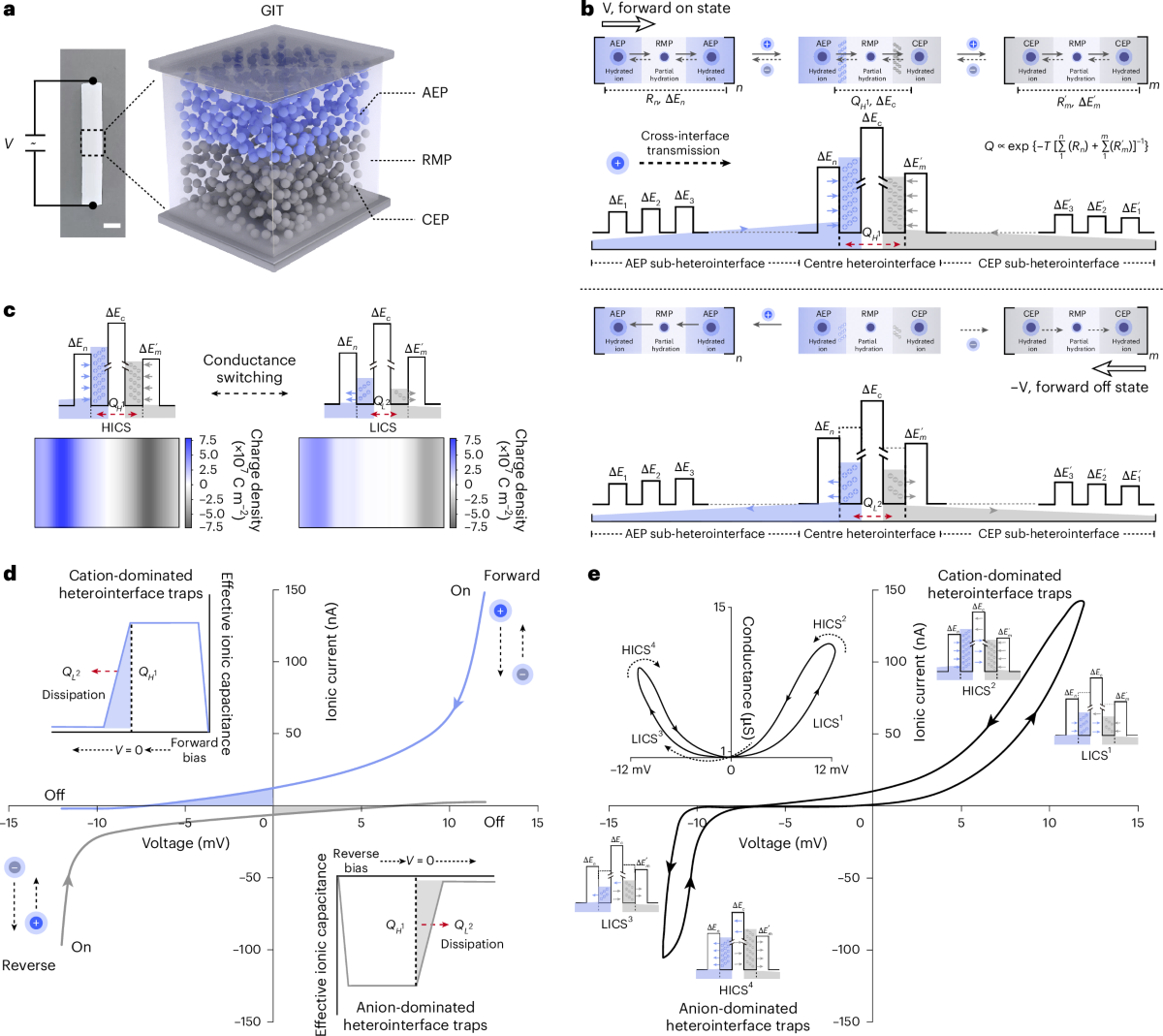
A Nature Electronics paper published September 10 describes a multiphase gel that controls ion transport through cascaded interfaces. The team, led by Ziguang Zhao, reports reversible changes in synaptic-like behavior and a two-channel device interfaced with a severed sciatic nerve preparation. This is an experimental material and biointerface result. It does not demonstrate a treatment for people, a complete artificial nervous system, or a computer with the capabilities of a brain.
The useful idea is that a material can retain a physical history of its inputs. Ions accumulate and leave interfacial traps under stimulation, changing how the device responds to subsequent pulses. The authors' institute reports millivolt-scale drive, rectification ratios reaching 10³, and a reported operation energy of 0.61 picojoules. Those figures describe specified device experiments. They should not be promoted into the energy budget of an entire implanted system, which would also include sensing, packaging, communication, and any supporting electronics.
Electronic circuits normally move charge through conductors and semiconductors; biological neural signaling depends on ionic concentrations and membrane dynamics. Connecting the two requires an interface that translates between physical mechanisms. A soft ionic material is interesting because some of its transport and mechanical properties can be designed around the biological side of that boundary. Compatibility still has several meanings. Carrying ions, matching mechanical softness, remaining chemically stable, and being tolerated by tissue are separate requirements.
A memory effect can arise when the device's internal state relaxes more slowly than the input pulse. Imagine a pulse that redistributes ions near an interface. A second pulse arrives before the distribution returns to equilibrium, so it sees a different conductance. Repeated stimulation can strengthen or weaken the response depending on the transport mechanism and stimulus history. This general picture explains why timing matters in a neuromorphic device: the order and spacing of inputs become part of the computation, rather than being discarded once each pulse ends.
The word synapse can obscure as much as it explains. A device may reproduce a particular relationship between stimulation and conductance without reproducing every biological process in a synapse. Showing facilitation, depression, or a learning-rule-shaped response is a functional analogy. It can be useful for signal processing even if the underlying chemistry is different. The evaluation should ask what operation the device reliably implements, under what conditions, and how accurately that operation can be composed with others.
Composition is the hard part for analog computing. If one element's state depends on nearby ion motion, temperature, hydration, or previous pulses, putting many elements together can change their behavior. Variation may be tolerable when the algorithm learns around it; it becomes costly when each device needs individual calibration. A large array also needs ways to address elements, read state without disturbing it excessively, and separate intended coupling from cross-talk. A low-energy element can be surrounded by a relatively expensive control system.
Retention presents a similar tradeoff. A state that persists is useful as memory, but a state that never relaxes can make adaptation or reset difficult. Short-term dynamics can filter a signal, while long-term changes can store a learned relationship. The right balance depends on the application. A nerve-interface experiment may value temporal response to biological pulses more than the stable numerical precision expected from a digital memory cell. Comparing them only by bits or joules would miss the task each device is meant to perform.
The nerve experiment makes this more than a detached electrical analogy, while leaving substantial questions open. Long-term operation would need evidence about drift, repeated stimulation, tissue response, and stability in a changing chemical environment. A signal crossing an experimental interruption is a narrower result than restoring normal sensory or motor function in a living person. The attractive future application should motivate those tests rather than stand in for them.
What earns this paper space in a weekly engineering report is the attempt to put useful dynamics into the material itself. A silicon processor can emulate a history-dependent response in software. Here part of that response emerges from transport through the device. The potential benefit is doing less conversion and bookkeeping at the interface. The cost is that the physical state must remain controllable enough to be a component. The next breakthrough would be reproducible operation across many devices and long durations, with the surrounding system's costs included.
Connected hardware / security operations
The Cyber Resilience Act puts incident reporting on a clock
On September 11, ENISA launched the initial operating capability of the Cyber Resilience Act's Single Reporting Platform. Manufacturers' reporting obligations for actively exploited vulnerabilities and severe security incidents in products with digital elements began the same day. The European Commission describes an early warning within 24 hours of awareness and a fuller notification within 72 hours. This is the reporting phase of the law; the CRA's broader application date is December 11, 2027, and the Commission separately places the relevant open-source steward obligations in that later phase.
The final-report clocks also differ. For an actively exploited vulnerability, the Commission specifies no later than fourteen days after a corrective measure becomes available. For a severe incident, it specifies a month after the 72-hour notification. Treating all of these as one generic breach deadline would lose both the trigger and the sequence. The platform routes a report to the relevant national incident-response team and ENISA under the prescribed arrangements, reducing the need to submit the same information separately to every authority.
For a hardware company, the engineering consequence begins before anyone opens a reporting form. The company has to recognize which shipped products contain a vulnerable component and which versions are affected. A firmware image may include an operating system, libraries, drivers, a bootloader, and third-party services. If those dependencies are not recorded against actual releases, incident response starts with archaeology. A bill of materials is useful only when it maps to what customers really received, including field updates and regional variants.
Consider a hypothetical camera vendor that learns an attacker is exploiting a library it uses. The first question is whether the affected code is present and reachable in its product. The second is which deployed versions expose it. The third is what customers can do while a fix is prepared. A team that can answer those from versioned release records has a different first day from a team searching old laptops for build environments. The law creates a time constraint around a capability that was already operationally valuable.
Detection and certainty arrive at different speeds. An early warning can be necessary before an investigation establishes every detail. That creates a reason to record what is known, what is inferred, and what remains unverified, with timestamps and ownership. It does not justify inventing a complete account to fill a form. A useful internal workflow preserves evidence and updates the report as the investigation progresses. The organization must be able to revise its understanding without losing the history of why it initially acted.
Patching a connected device is also a physical deployment problem. Some devices are intermittently online. Some customers delay updates because downtime is expensive. An interrupted firmware installation can create its own failure. Signed updates, rollback protection, recovery images, and staged rollout are mechanisms for managing those risks, but their configuration must fit the product. A patch that exists on a server has not necessarily reduced exposure across the installed fleet.
This changes incentives for product planning. A low-priced device with a long field life can create years of security work after the initial sale. If a business model treats that work as an unexpected expense, the company has underpriced its own product. The reporting deadline makes the mismatch harder to ignore, but it does not determine the right support economics. Subscription revenue, service contracts, shared maintenance infrastructure, and a narrower supported configuration set are possible responses, each with tradeoffs for customers.
There is a reasonable concern that reporting diverts a small team's attention during an incident. A single platform can reduce some duplication, while preparation can reduce the burden of assembling basic facts under pressure. The difficult work remains triage and remediation. A company that optimizes for submitting forms while leaving customers unable to update has satisfied the wrong operational objective. Conversely, a good engineering response still needs clear communication so affected parties can act.
The week’s change is therefore concrete: the reporting mechanism is operating and the first manufacturer obligations have started. It is not evidence that every connected product has suddenly become secure. For founders building robots, sensors, or industrial appliances, the useful question is whether a release can be traced, a vulnerability assessed, and a response coordinated within the product's real operating conditions. That capability belongs beside manufacturing and customer support in the cost of shipping hardware.

Maven has to account for the hours between demonstrations. Relativity has to turn access to procurement into a service a mission can use. The ionic device has to preserve useful behavior outside a carefully arranged experiment. Connected-product vendors have to know what they shipped when an incident starts. These are different versions of carrying a result into ordinary operation.
That is where I would spend the next round of diligence: the records, interfaces, and repeat tests that make a promising result usable by someone who did not build it. A technology becomes much more interesting when the next person can rely on it without keeping its inventors in the room.