Frontier MechanicsField report / 108
Frontier Mechanics Week 108: WeatherNext watches the sky, NVIDIA buys model distribution, Cluster burns up on camera, and PhyFilter corrects a robot's mistakes
Hourly weather forecasts, a $12.93 billion platform agreement, airborne reentry observations, and feedback control that helps learned policies cope with unfamiliar physics. Reporting for August 31-September 6, 2026.
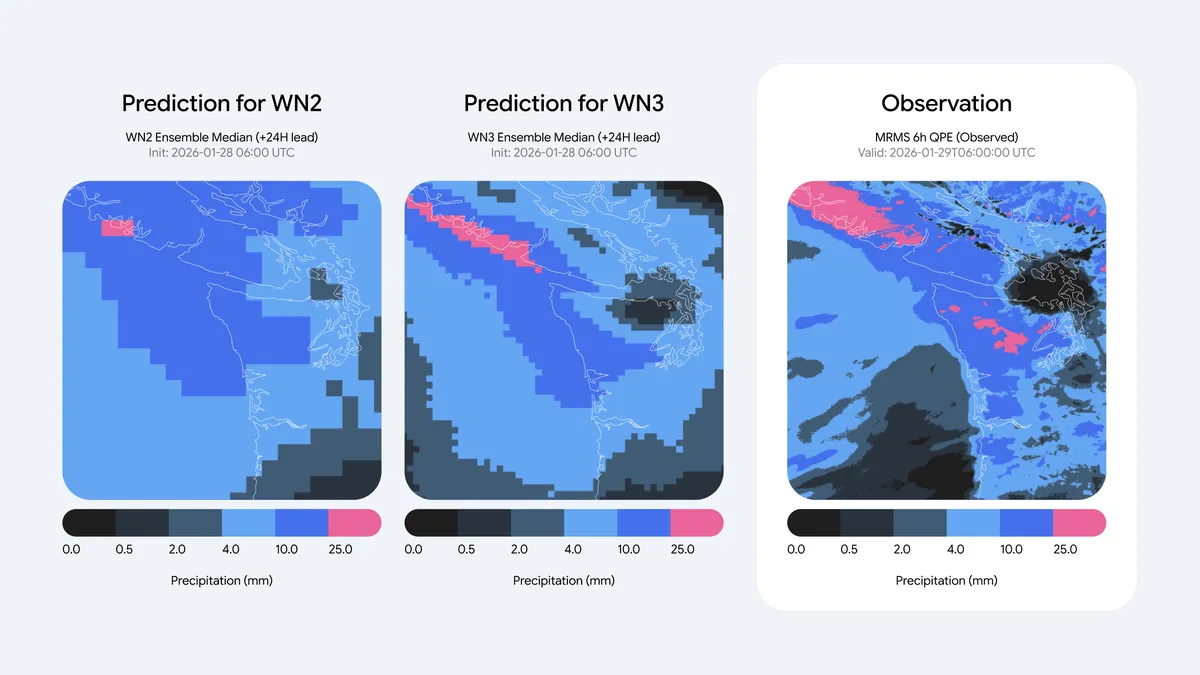
The forecast looks sharper. That is the first thing a reader notices in Google's WeatherNext 3 comparison images. The more consequential change is upstream: the system can ingest recent satellite observations instead of waiting entirely on an older atmospheric analysis. Better predictions can come from giving a model a more current world, even before making the model cleverer.
That question of access runs through this week's other stories. NVIDIA agreed to buy the place where millions of people find and distribute models. ESA put an aircraft in position to watch two satellites disintegrate. A robotics paper showed how measured feedback can correct a learned policy when the physical world changes. The useful detail in each case is how information reaches the system, and what the system is allowed to conclude from it.
AI / weather / energy
WeatherNext 3 gives the forecast a fresher atmosphere
Google introduced WeatherNext 3 on September 3, alongside its technical paper. The system refreshes forecasts hourly using low-latency geostationary satellite observations. Google describes 5-kilometer output for selected near-surface variables, 10-kilometer output for other surface fields, and 25-kilometer output for atmospheric variables. That qualification is essential: the announcement does not say that every variable in the atmosphere is resolved on a 5-kilometer grid.
The paper distinguishes gridded fields from predictions at sparse observation locations. Its single-level fields use 0.1-degree resolution, while temperature and dewpoint can be predicted at arbitrary locations using local geographical information. It also learns from station observations and satellite-derived precipitation. A location-conditioned estimate and a full dynamical simulation at the same nominal spacing are different constructions. Both can be useful, but a map with small pixels does not establish that every small-scale physical process has been explicitly simulated.
Conventional forecasting has to infer the atmosphere's current state from incomplete measurements before evolving that state forward. A thermometer samples one place; a satellite sees radiation integrated through particular wavelengths and viewing geometries. Neither supplies every temperature, pressure, moisture, and wind value needed by a global model. Data assimilation reconciles those observations with prior physical estimates. An AI model trained only on the resulting analyses inherits their strengths, omissions, and delays. WeatherNext's direct use of observations changes where some of that inference happens.
Imagine a front developing after the last six-hour analysis cycle. A fast model can produce a forecast in seconds and still begin from a state that misses the front's latest movement. Cutting compute time does not recover an observation the model never received. Hourly satellite inputs address that particular problem. They do not make the atmosphere fully observed: clouds obscure some measurements, instruments have biases, and surface conditions can remain difficult to infer. Fresh data is useful evidence, not a substitute for uncertainty.
Precipitation exposes the difference between a visually satisfying forecast and a statistically useful one. If ten plausible storms put a narrow rain band in ten slightly different locations, their average may show a wide patch of light rain that no individual outcome resembles. An ensemble preserves alternative futures, allowing a user to ask about the probability of crossing a threshold. Google's release reports gains using the continuous ranked probability score, or CRPS, with different improvements against different observation products. The largest percentage should not be translated into an equally large improvement for every location, lead time, or kind of weather.
CRPS compares a forecast's cumulative probability distribution with the outcome that occurred. It rewards a distribution that puts its probability mass near the truth while penalizing unnecessary spread. That helps distinguish a model that is cautiously informative from one that announces every outcome as possible. It still needs evaluation by region and weather regime. A strong average over ordinary days can coexist with weak performance on the rare threshold that closes a port or overloads a drainage system. The operator pays for the latter, even if the benchmark is dominated by the former.
Energy is a particularly concrete application. Google includes turbine-height wind and solar-related variables. A wind farm does not convert wind speed linearly into power across its operating range, and a solar plant's output depends on when clouds arrive as well as their daily average cover. A grid operator therefore needs joint scenarios through time, not simply the best estimate at each hour. Ten individually reasonable hourly forecasts can describe an impossible sequence when stitched together. Consistency matters because storage, ramping, and reserve decisions connect those hours.
Consider a hypothetical operator choosing between buying reserve power for $10,000 and accepting a $200,000 loss if a shortage occurs. Ignoring other constraints, the break-even shortage probability is five percent. A forecast that moves a calibrated probability from eight percent to three percent changes an action. A more attractive temperature map may not. This is the distinction between forecast skill and decision value. The practical test for WeatherNext is whether its additional resolution and faster updates improve the probabilities that specific users act on, using observations held out from training and comparisons that were fixed before the weather happened.
AI infrastructure / platform economics
NVIDIA buys the place where models become somebody else's software
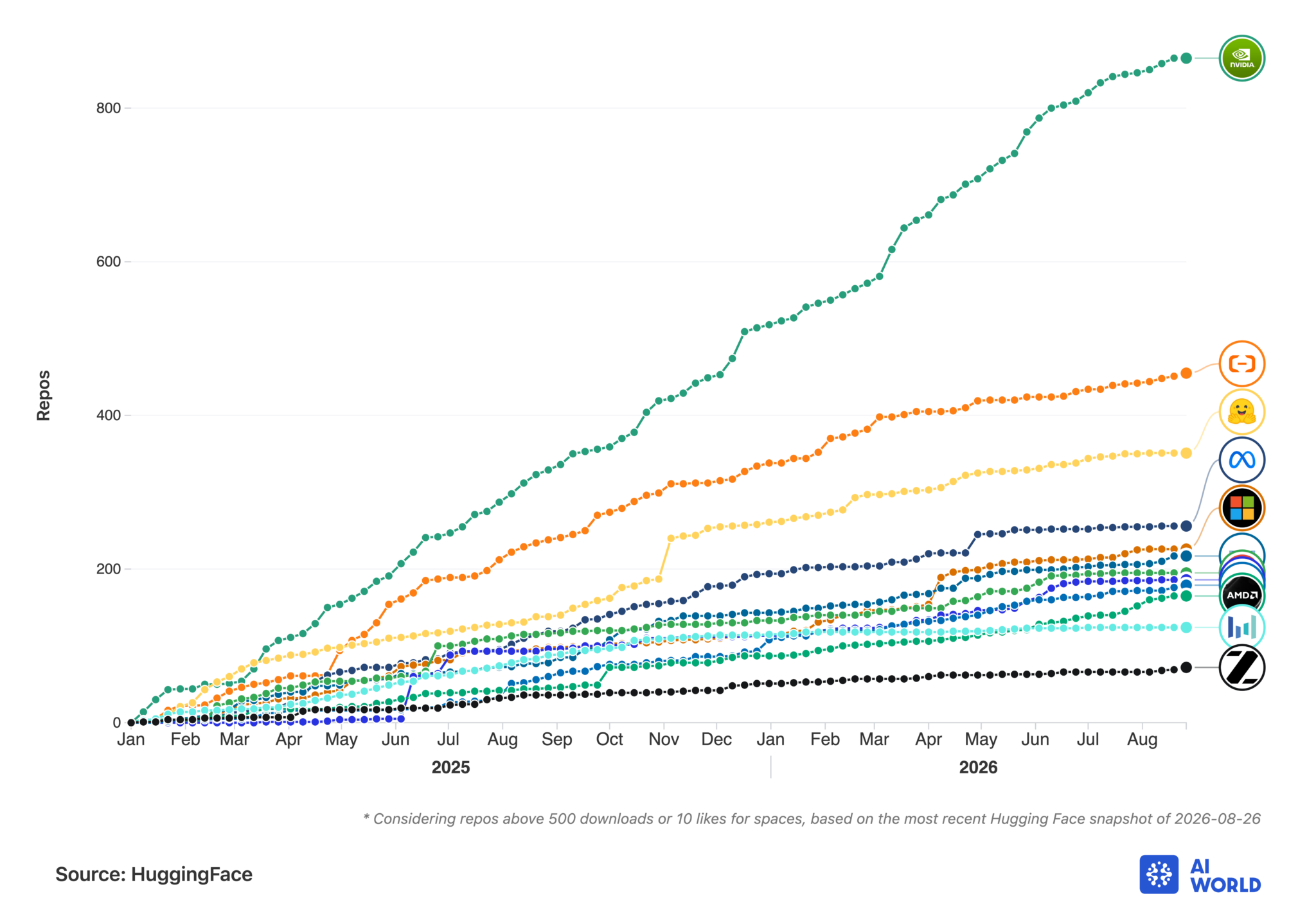
NVIDIA announced on September 3 that it had agreed to acquire Hugging Face for $12,930,300,000. Jensen Huang's statement promised continued support for other clouds, inference providers, frameworks, and accelerators, explicitly saying NVIDIA compute would not be required. The release described a platform used by more than 18 million developers, researchers, and creators. This week's event is the agreement and the stated commitment to openness; it should not be rewritten as a completed integration with demonstrated outcomes.
The strategic attraction is easy to understand without assuming a plan to close the platform. Hardware becomes more useful when more people can find software that runs on it. A repository lowers the cost of discovering a model, checking its license, downloading weights, finding examples, and putting it into an application. If those steps become easier, demand for inference and training can grow. A hardware supplier may rationally fund an open software layer because openness expands the market for a complementary product.
There is also a subtler form of influence than refusing to support competing chips. Defaults matter. A tutorial chooses one backend. A benchmark uses one numerical precision. A deployment button selects one runtime. An optimization lands on one architecture months before another. None of those choices necessarily prevents portability, yet together they can change the amount of engineering needed to exercise it. A serious assessment of the promise should examine the cost of using an alternative, not just whether an alternative appears in a dropdown.
A model repository is more than a folder of weights. Reproducibility also depends on tokenizer versions, configuration, preprocessing, inference code, dependencies, and the exact revision downloaded. A model card can explain training data, intended uses, evaluations, and limitations, but those fields are information supplied by its authors rather than a universal certification. An organization deploying from the Hub still needs to identify the artifact it tested and make sure the artifact reaching production is the same one. Popularity does not perform that check.
This becomes a software supply-chain problem as soon as an application loads external code or dependencies. Weight serialization and executable behavior should be distinguished. Safetensors addresses a narrower concern by storing tensors in a format designed for safe loading; it does not make every script, package, or model behavior surrounding those tensors trustworthy. Pinning revisions, reviewing required code, recording hashes, and testing in a restricted environment remain useful. Buying the repository can fund those capabilities, but ownership alone cannot prove that every uploaded artifact is benign.
For a startup, the acquisition creates a two-sided dependency. The company may gain a better-funded service with more reliable downloads and deployment tooling. It may also depend more heavily on infrastructure owned by a supplier whose incentives differ from its own. Imagine a team that can move its model to another cloud in a day but would need six months to replace its evaluation, dataset, and deployment workflow. Its weights are portable; its operating process is less so. The relevant switching cost sits across the whole workflow.
The strongest argument for the deal is operational. Serving a large community, storing large artifacts, handling abuse, and maintaining compatibility all cost money. An owner with substantial infrastructure and engineering resources can support a service that users expect to be cheap or free. The strongest concern is governance: a promise about neutral access is only as durable as the incentives and mechanisms supporting it. Transparent compatibility work, stable APIs, export paths, and published treatment of competing runtimes would be more informative than repeating the word open.
An acquisition price does not tell us how much of that value belongs to current revenue, future revenue, developer relationships, or strategic defense. Those are different explanations that can coexist. My reading is that distribution has become important enough for a chip company to pay for it directly. The follow-up questions are measurable: do independent model builders keep publishing there, do non-NVIDIA deployments remain first-class, and can users leave with their artifacts and workflows intact? Those will reveal more about the acquisition than the first week of assurances.
Space safety / flight experiments
Cluster's last experiment is a carefully observed breakup
ESA's Samba spacecraft reentered on August 31, followed by Tango on September 1. These were the last two satellites in the four-spacecraft Cluster mission. An airborne team observed both breakups with 29 of its 30 instruments, collecting roughly fifty seconds of observations per event. ESA reported the successful campaign on September 2. After decades studying Earth's magnetic environment, the spacecraft supplied one final set of measurements by becoming the experiment.
The flights were targeted reentries over a remote part of the South Pacific. That wording describes an orbital strategy; it does not imply a spacecraft steering through the atmosphere to a landing point. Operators arranged the trajectory so the vehicle's eventual encounter with dense air would occur in a suitable region. The observation aircraft then had to reach the right viewing geometry within that predicted window. It is an unusual coordination problem: the subject is moving at orbital speed, getting brighter, breaking apart, and disappearing while the camera platform is also moving.
A spacecraft's breakup is difficult to validate using ground tests alone. Different materials have different melting and oxidation behavior. Structural joints fail under combinations of heating and aerodynamic load. Once a panel detaches, previously shielded components can receive much more heat. Each fragment acquires its own orientation, drag, and thermal history. A model that gets the total energy approximately right can still get the surviving fragments wrong, which is the part relevant to people on the ground.
A simple way to see the coupling is through ballistic coefficient, mass divided by drag coefficient times reference area. A compact, heavy fragment can penetrate farther than a light object with a large area, all else equal. But area and drag change with tumbling and breakup, and the atmosphere varies. The calculation needs a sequence of shapes and conditions rather than a single spacecraft silhouette. Observations constrain when those transitions occurred and how the visible pieces behaved afterward.
Brightness is not a direct scale reading for remaining mass. It depends on temperature, composition, emitting area, and viewing conditions. Spectral measurements can help identify emitting species, while images constrain trajectories and fragmentation. Different instruments supply different pieces of the reconstruction. The value of putting many instruments on one aircraft is that their measurements can be aligned to the same event. A beautiful streak in one camera is a photograph; synchronized measurements can become a test of a breakup model.
Cluster also offers a rare experimental advantage: several broadly comparable spacecraft returning under different conditions. In most accidental reentries, researchers get whatever object and geometry happen to arrive, often with incomplete construction information. Repeated observations of a known family make it easier to separate material and structural behavior from the particular trajectory. They still do not create a perfectly controlled experiment. Aging, fuel state, attitude, and observation conditions can differ. Those differences belong in the reconstruction rather than being averaged away.
Designing a satellite to disappear safely involves tradeoffs with designing it to survive launch and operations. A component that opens earlier during reentry may expose its contents to more heating, but the same feature must remain secure through vibration, thermal cycling, and years in orbit. A pressure vessel may be necessary for the mission and unusually resistant to destruction. The engineering task is to specify the conditions under which a structure should remain intact and the conditions under which it should stop protecting itself.
Even complete atmospheric destruction would not mean the material ceased to exist. Fragment survival at the surface and the atmospheric consequences of ablated material are separate questions. The observations improve evidence about the destructive process; they do not, by themselves, settle every environmental effect of increasing reentry traffic. That distinction matters as disposal becomes routine. Removing an object from orbit solves one problem while moving its material somewhere else.
The campaign's achievement is that a planned end of life produced inspectable data. The next useful output will be comparisons between predicted and observed breakup, with uncertainties carried into models used for future vehicles. A model that predicts the wrong sequence but the right total light should not receive full credit. The point of watching a spacecraft burn is to learn which parts of the calculation were wrong while there is still time to change the next spacecraft.
Robotics / control theory
PhyFilter lets a robot correct the physics it did not learn
A September 4 paper in npj Robotics describes PhyFilter, a feedback module that corrects learned outputs using known physical structure and measured state. The authors test quadruped locomotion, drone flight, aerial manipulation, and acceleration estimation. In their flight implementations, the correction ran at 500 Hz on an STM32F765 microcontroller. That makes the work interesting for a different reason than a large foundation model: it asks how much useful adaptation can fit into a small, fast control loop.
A learned dynamics model predicts how the system responds. Its residual is the difference between that prediction and the unknown true behavior. During deployment there is usually no oracle supplying the true residual directly. The paper constructs an equivalent filtered correction using the differential equations' structure and observed state. Its aim is to capture the slower component of the mismatch without differentiating noisy measurements indiscriminately. The published experiments support that approach in the tested conditions, not universal robustness to every disturbance.
For intuition, imagine a drone that has learned to hold position with a particular payload. Add a small weight and its old thrust command produces a persistent downward error. A correction loop can infer that the nominal model is insufficient and supply additional effort. If a gust changes rapidly, the same loop must distinguish a sustained force from measurement noise and transients. A filter is useful because it imposes a timescale on that inference. It is also a limitation: disturbances outside its effective bandwidth will not be canceled simply because they exist.
A first-order low-pass filter with transfer function a/(s+a) illustrates the tradeoff. Increasing a lets the estimate respond faster, but passes more high-frequency noise and can interact with actuator delay. Decreasing it smooths the estimate while allowing a longer error after a change. This example is a general control illustration, not a claim that every PhyFilter experiment uses this exact scalar controller. Real robots couple axes, impose saturation, and sample measurements at finite intervals. Filter parameters have to make sense within that complete loop.
The result is relevant to the debate over robot data because some uncertainty is easier to measure online than to enumerate during training. A policy could see thousands of payloads in simulation and still encounter a new combination of friction, mass, and actuator wear. Feedback offers another source of information after the robot begins moving. That does not make visual understanding or task demonstrations unnecessary. It means that learning what to do and correcting how the machine responds need not be solved by the same mechanism at the same timescale.
A useful boundary is between a dynamics error and a task error. If the robot knows the correct foothold but its leg produces less torque than expected, adaptation may help. If it has selected a foothold on a surface that will collapse, additional control effort may make the failure faster. Similarly, compensating for wind does not tell a drone whether it is allowed to enter an area. Calling all of these failures generalization can obscure which evidence and which layer of the stack are required to address them.
The paper's experimental comparisons should be read with that scope in mind. Terrain, payload, and wind tests probe particular shifts relative to training. A deployment assessment would also examine sensor faults, delayed observations, actuator limits, contact changes, and recovery after a large disturbance. Those are suggested extensions, not claims about unreported failures. A correction that works beautifully while an actuator has spare authority may behave differently once the command saturates. The model's error can continue to grow even though the motor has nothing left to give.
I would also separate adaptation quality from safety certification. An estimator converging under stated assumptions is useful; proving the full robot remains within a safe set under every permitted condition is a larger task. The correction can be one component of such a system, with independent limits and fallbacks around it. It should not silently become permission for the planner to assume that any dynamics mismatch will be repaired downstream.
The appeal is practical. There is a large installed base of policies and controllers that are imperfect but useful. A small module that improves their behavior under unfamiliar loads may be easier to deploy than a completely new training pipeline. The next convincing evidence would compare intervention rates and failure modes over longer operation, keeping the underlying policy and hardware fixed. That would show whether the correction buys durable reliability rather than a better performance on the handful of disturbances chosen for a paper.
Fresh observations helped the weather model; physical feedback helped the robot; synchronized instruments made a spacecraft's breakup informative. None of those improvements came merely from collecting more of the same data. The source, timing, and independence of the measurement mattered.
Hugging Face sits at a different point in that chain: it distributes the artifacts people build from those measurements. Its next owner's choices will influence how easily the rest of us can inspect, reproduce, and deploy them. That is a concrete responsibility for a platform whose central promise is access.